


Deck building basics
How to build a consistent Pokémon TCG deck
DeckSequence · Updated · 6 min read
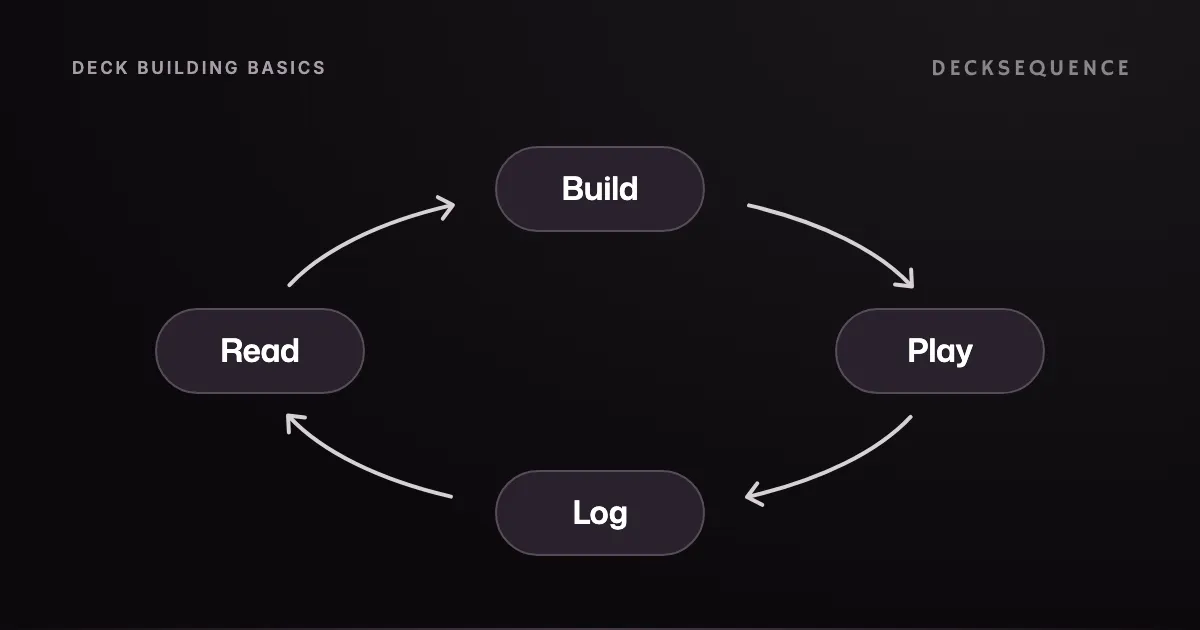
A lot of the games you lose to your own deck don't feel like deck problems at the time. You bricked, you mulliganed twice, your attacker showed up a turn late. Those are consistency problems, and more of them can be measured than most players realize.
This article covers the basics and links to a longer piece on each topic. Most of the numbers in it come straight from a decklist.
The limits you build inside
A Standard deck is exactly 60 cards. You can run up to 4 copies of any card with the same name, except basic Energy, which has no limit, and only one ACE SPEC in the whole deck. You set aside 6 Prize cards at the start of every match, so those 6 are out of reach until you take a knockout.
How much Energy to run
There's no fixed number. Work out how many attachments your deck needs by its second turn and how badly it needs the first one, then check the odds. With 10 Energy in 60 cards, you open with at least one 74.1% of the time, and by your second turn you've seen one 83.1% of the time. Cards that search for Energy count toward the same goal, so a list with good search can run fewer. Once the deck is in DeckSequence, you can group the Energy with the cards that find it and see the combined odds on the deck's Odds page.
Start with how many copies you run
A deck is 60 cards and your opening hand is 7 of them. With 4 copies of a card, you'll open with at least one 39.9% of the time. With a single copy, it's 11.7%.
Each copy you add helps less than the one before it. Going from 1 to 2 copies adds 10.5 points, while going from 3 to 4 adds 8.4 points. So the fourth copy of anything should be there for a reason. How draw odds work has the full table.
Your Basic count sets your mulligan rate
You only mulligan when your opening 7 has no Basic Pokémon. A hand with no Supporter or no Energy still gets kept. That makes your Basic count the number that decides how often you mulligan.
With 10 Basics in 60 cards you'll mulligan in 25.9% of your games. With 14 Basics it drops to 13.9%. Plenty of good decks accept the higher rate because the extra slots go to cards that do more, but make that choice knowingly. When you add a list to DeckSequence, its mulligan rate is on the deck's Odds page, and mulligan math goes through the whole range.
Going first changes what you can do, not what you draw
Both players draw at the start of every turn, including the player going first on turn 1. By your second turn you've seen 9 cards whichever seat you're in, and a 4-of has shown up 48.8% of the time.
The difference is what you're allowed to do with those cards. Going first, you can't play a Supporter or attack on your first turn, apart from the odd card like Carmine that says otherwise. Going second, you can do both. If your setup depends on a turn-one draw Supporter, going first pushes it back a turn. Going first or second covers how to pick your seat.
Play order matters
The same hand played in a different order wins a different number of games. As a general rule, play your search cards before anything that shuffles or discards your hand, pull out what you need from the deck, and draw last. Each decision is usually worth less than a percentage point, but you make hundreds of them over a tournament.
The sequencing article works through an example with real numbers. To check your own play, paste your PTCG Live battle logs into DeckSequence. It rebuilds each game turn by turn, so you can see the order you actually played things in.
Test your changes properly
Once the list is built, you have to find out whether it works, and it's easy to fool yourself in either direction.
- Know what the numbers say before you start testing. Your deck's theory floor is what your opening hand and one draw a turn should give you with no search at all. Theory vs practice explains how to compare your results with it.
- Judge cards on what they did in your games. If a card sits dead in your hand in a quarter of them, that's telling you something. See card utilization.
- Be wary of small samples. Five games tell you very little, and a win rate against one particular deck needs around 50 games against it before it settles down. DeckSequence labels a deck's win rate as a small sample until enough games are behind it, and why small samples lie has the numbers.
- Keep the list and the pilot separate. Some losses are variance, some are the deck and some are misplays. The six play disciplines help you sort out the last group.
If you'd rather not keep all of this in a spreadsheet, sign up for DeckSequence and add your first deck. Its odds, your logged games and their replays all end up in one place.