


Testing & data
Which cards earn their slot? Reading card utilization
DeckSequence · Updated · 5 min read
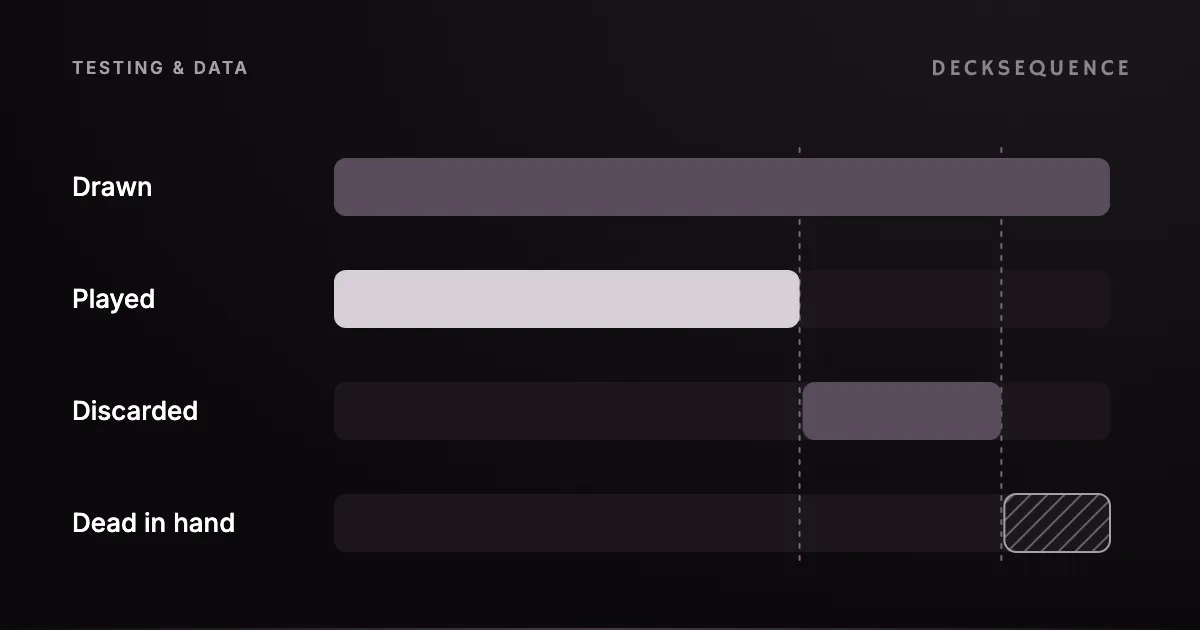
Most decks have a card the player will defend in theory and never actually use. You can find it by feel over a few months, or you can find it in a decent sample of logged games.
Four rates tell you most of what you need to know, and you count them yourself from your games. If you log your games in DeckSequence with their PTCG Live battle logs, each one has a replay, and counting a game takes a minute or two.
The four rates
- Drawn: games where you drew the card at least once.
- Played: of the games where you drew it, how many you actually used it in.
- Discarded: of those same games, how many it ended up in the discard pile, whether it was paid as a cost, discarded from your hand or got there some other way.
- Dead in hand: of those games, how many it was still sitting in your hand, unused, when the game ended. Leave out games where you only drew it on your last turn. This is the one to watch most closely.
Dead in hand is also the quickest to check. Step to the final turn of a replay and whatever never left your hand is right there.
Count games, not copies. Drawing two Ultra Ball in one game counts as one game where Ultra Ball was drawn. Rates per game answer the question you actually care about when building: when this card shows up, does it do anything?
Judge each card by its job
The same numbers mean different things for different cards, so compare each card with what it's in the deck to do.
- Cards with a core job, like your attackers and your draw and search engine, should be getting used. If one of them is dead in a quarter of your games, or drawn often but rarely played, it's a real cut candidate, or a sign the list can't support it.
- Situational cards such as Stadiums, tech Items and counter cards are supposed to sit idle some of the time. Go easy on them. Only flag one if its dead-in-hand rate is really high, or if it did nothing in the matchup it was there for.
Two rules before you cut anything
First, a lack of data isn't a reason to cut. A card you haven't drawn in any logged game hasn't earned a verdict either way. Second, per-card rates need more games than deck-level ones. You want around 30 games where the card actually showed up before its numbers are worth acting on, and a one-of's dead-in-hand rate after eight games is an anecdote.
Compare it with the theory
Draw math tells you how often each copy count should show up, and the theory floor tells you what your draws alone should give you. Your counts show what each slot actually did. A card the math says should show up regularly, and that does nothing when it does, is the easiest cut you'll make.
When you make that cut, save the new list as a new version of the deck in DeckSequence. It keeps your version history, and once the new version has a real sample behind it, Compare Versions shows both versions' matchup records side by side. Sign up and start logging.