


Testing & data
Theory vs practice: testing a deck without fooling yourself
DeckSequence · Updated · 5 min read
Testing a new deck tends to go one of two ways. Either you fall for it, and every win proves the list while every loss was bad luck, or you panic and start cutting cards after three bad games. Both happen for the same reason: there's nothing to compare the results with. So before you test, work out what the list should do on draws alone, then compare your logged games with that.
The theory floor
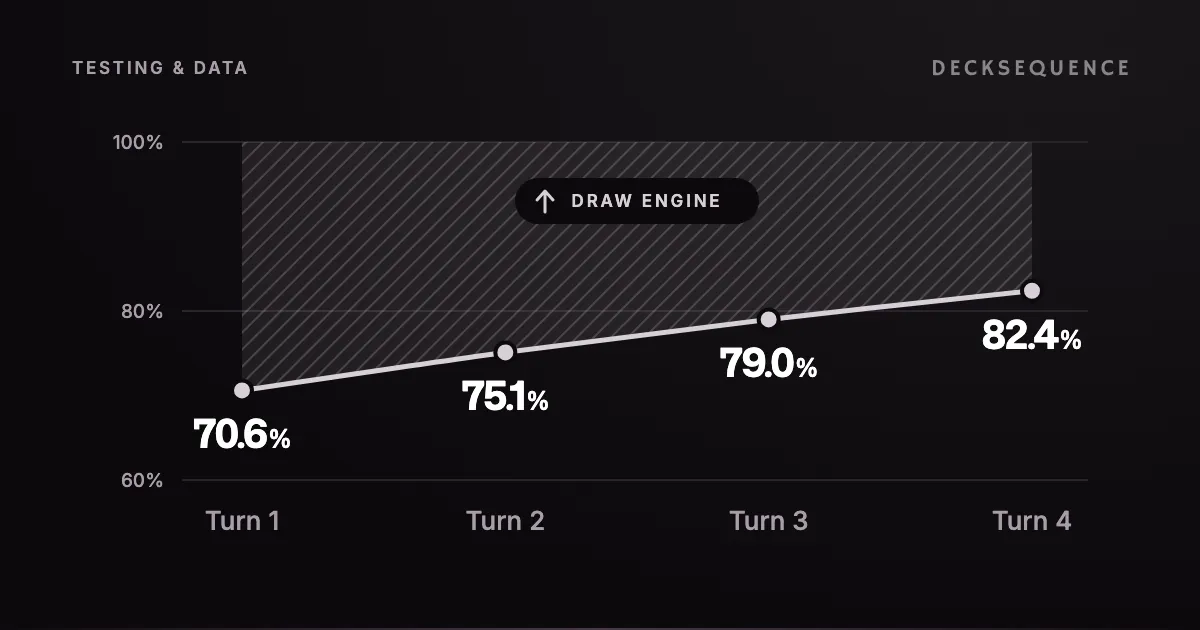
Pick a question the math can answer exactly, like "how often have I seen a Basic attacker by my second turn?" Say your list runs 8 Basics that can attack. By your second turn you've seen 9 cards (your opening 7 plus one draw a turn), so the chance that at least one of those 8 is among them is 75.1%.
A deck's Odds page in DeckSequence gives you this kind of number for your own list: the odds of having seen a Basic, a Supporter or an Energy by each turn, and the same for any group of cards you set up, like your Basic attackers.
That number only counts your opening hand and the card you draw each turn. It ignores Ultra Ball, Lillie's Determination and every other way of finding cards, and it ignores mulligans, which push the odds of a Basic up. So treat it as a floor. A real deck with a working engine should do better than this.
The floor is the same in either seat
Both players draw at the start of every turn, the first one included, so you see the same number of cards whether you go first or second:
| Your turn | Cards seen | At least one of 8 |
|---|---|---|
| 1 | 8 | 70.6% |
| 2 | 9 | 75.1% |
| 3 | 10 | 79.0% |
| 4 | 11 | 82.4% |
What changes is what you can do on turn 1. Going first, you can't play a Supporter. If your setup relies on a turn-one draw Supporter, look at your results for each seat separately before you compare them with the floor.
Some questions are harder than they look
The floor works best for "have I seen this card yet?" questions. It gets trickier when the rules matter as much as the draws. A Stage 2 attacker can't be in play before your second turn however well you draw, because nobody can evolve on their own first turn, and Rare Candy can't be played on your first turn either.
So a Stage 2 attacker on turn 1 is impossible. To have one on turn 2, you need the Basic in play on turn 1, then the Stage 2 and Rare Candy by turn 2. Requirements like that have to be calculated together. The sequencing article shows why working them out separately and multiplying doesn't work, and the combo odds on the Odds page give you the chance of holding the pieces at the same time.
Comparing your results
Now log your games and see where you land. You count this side yourself. If you log your games in DeckSequence with their PTCG Live battle logs, step each replay to your second turn and note whether an attacker was down. Twenty or thirty games of tallies will tell you which side of the floor you're on.
- Above the floor is normal for a tuned deck. It means your draw and search cards are doing their job.
- Close to the floor means you're getting about what raw draws would give you. That's fine, but check whether your engine cards are earning their slots. Card utilization helps with that.
- Below the floor is worth a closer look, because something is costing you consistency your list should have.
Falling short doesn't mean you misplayed
Being below the floor could be variance, because small samples swing a lot. It could be the list, if the engine can't actually find the pieces. Or it could be play, if hands are being sequenced badly. The comparison tells you where to start looking, and after twelve games it can't tell you much more than that.
Make it a routine
Before you test a change, write down what the numbers predict. Saving the change as a new version of the deck in DeckSequence keeps the before and after separate, and once the new version has a real sample behind it, Compare Versions shows the two versions' matchup records side by side. Sign up and add your first deck.