


Deck building basics
Mulligan math: how many Basic Pokémon should you run?
DeckSequence · Updated · 4 min read
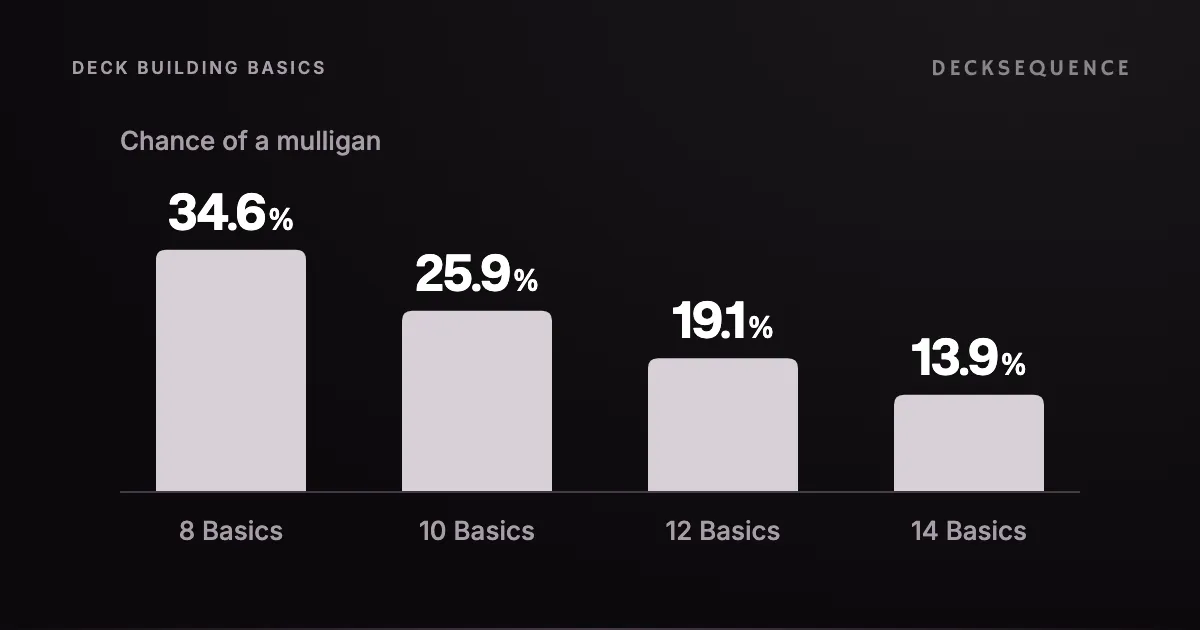
You mulligan when your opening 7 has no Basic Pokémon. Missing a Supporter or an Energy won't cause one. Basics are the only cards that make a hand keepable, so your Basic count is the biggest consistency lever you have, and it's one you can set precisely.
How often you'll mulligan
Your mulligan rate is the chance that none of your Basics land in a random 7 cards from 60. It's the "at least one" math from the draw odds article, turned around:
| Basic Pokémon in your deck | Opening hands with no Basic |
|---|---|
| 8 | 34.6% |
| 10 | 25.9% |
| 12 | 19.1% |
| 14 | 13.9% |
A 10-Basic deck mulligans in about a quarter of its games (25.9%). Plenty of competitive lists run around that many and accept the cost, because the slots they save go to stronger cards.
For your own deck you don't need the table. Add the list to DeckSequence and its mulligan rate is on the deck's Odds page. The same number shows on the deck's share page, so anyone you send the list to sees it too.
What a mulligan costs you
Redrawing isn't the only cost. Your opponent gets a look at the hand you revealed, and they may draw an extra card for each mulligan you took beyond any they took themselves, benching any Basics they find. If neither player has a Basic, you both reshuffle and redraw, and nobody gets extra cards.
Mulligans can also come back to back. Each redraw is a fresh shuffle, so a 10-Basic deck mulligans twice in a row in 6.7% of its games. That's rare, but over a long tournament it will happen to you.
Every Basic costs a slot
If avoiding mulligans were free, everyone would run 16 Basics. Every Basic you add is a slot you can't use for draw, search, Energy or a tech card. Decks with few Basics take more mulligans in exchange for power or speed, and decks with lots of them are steadier but less flexible.
Pick your count deliberately
When you build, check your mulligan rate and decide whether the rest of the list is worth it. The rate on the Odds page follows the current version of your deck, so note it before you cut a Basic for a tech card and look again after.
Check it against your games
Over enough games, the share of games where you mulliganed at least once should come close to the calculated rate. With only a handful of games it will bounce around a lot first (small samples lie).
If you paste your PTCG Live battle logs into DeckSequence, every game gets a turn-by-turn replay with the mulligans in it, so counting them across twenty games takes a few minutes. Openings are one of the six play disciplines.