


Playing better
Going first or second in the Pokémon TCG
DeckSequence · Updated · 5 min read
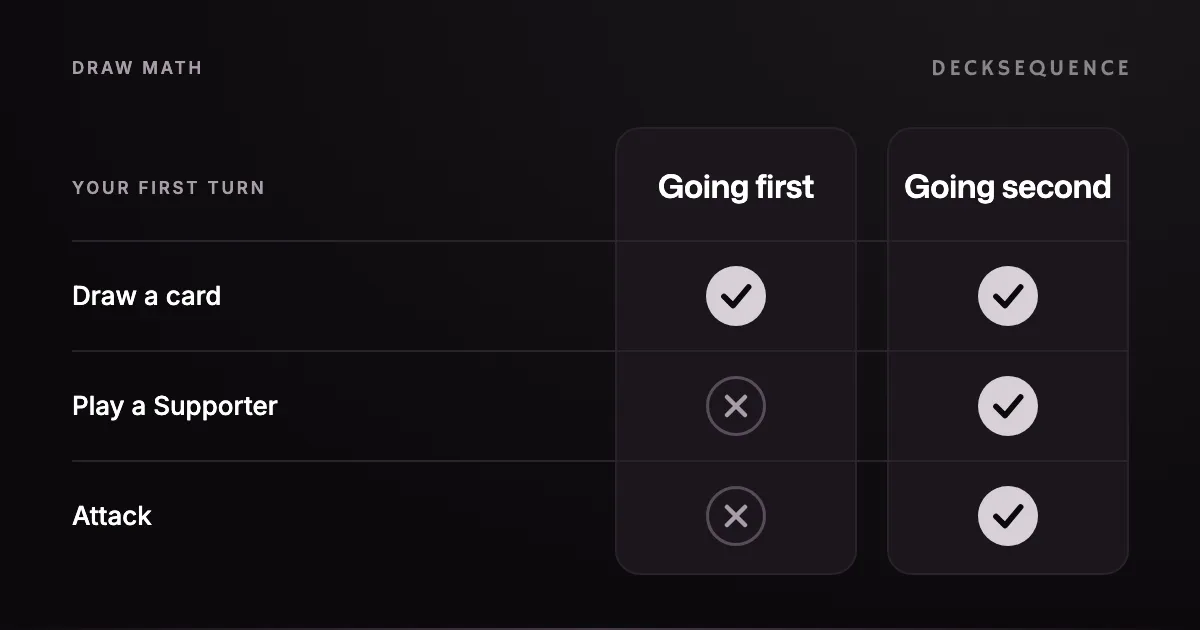
When you win the coin flip, you get to choose who goes first. A lot of players make that call on autopilot. It's worth knowing exactly what the choice changes, because some of the common advice about it is based on a rule the Pokémon TCG doesn't have.
Both players draw on turn 1
Every turn starts with a draw, and that includes the first turn of the game. Some card games make the first player skip their opening draw, but the Pokémon TCG isn't one of them.
So by your own turn N, you've seen your 7-card opening hand plus N draws, whichever seat you're in:
| Your turn | Cards seen, going first | Cards seen, going second |
|---|---|---|
| 1 | 8 | 8 |
| 2 | 9 | 9 |
| 3 | 10 | 10 |
| 4 | 11 | 11 |
Your draw odds are the same either way. A 4-of shows up by your second turn 48.8% of the time, going first or going second. The odds by turn on a deck's Odds page in DeckSequence are worked out the same way.
What going first costs
On your first turn going first, you can't play a Supporter and you can't attack. You can still play Items, use Abilities, bench Basics and attach an Energy. A few cards say otherwise: Carmine, for one, can be played on your first turn if you went first.
Losing the Supporter is the bigger deal. A draw Supporter like Lillie's Determination shuffles your hand away and draws you eight new cards while you still have all six Prizes, and going first you can't play it on turn 1. Your first turn has to work with the 8 cards you've seen plus whatever your Items and Abilities can find.
What going second gets
Going second, you're the first player who can attack, and you get a Supporter on your first turn. You also get to watch your opponent's whole first turn, including what they benched, attached and searched for, before you play a card.
The one thing you don't get is the first evolution. Nobody can evolve on their own first turn, so the player going first evolves on their second turn, which comes before yours.
Here are both first turns played out on the replay board DeckSequence builds from your PTCG Live battle logs:
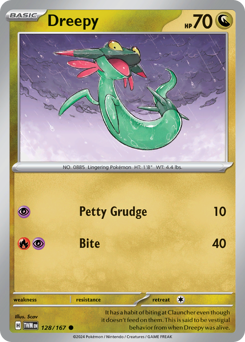
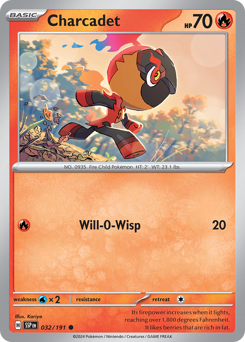
Hand6



Choosing your seat
Going first, you get the first Energy attachment and, a turn later, the first evolution. Going second, you attack first and have a Supporter on turn 1, but you're reacting to a board that's a turn ahead of yours.
Which is better depends on the deck. If your list needs a turn-one draw Supporter to set up, or it wants to take the first Knock Out, going second has a lot going for it. If it sets up with Items and Abilities and wants to evolve before the opponent can, going first is usually the better pick. Playing the seat you're in well is one of the six play disciplines.
Look at your results by seat
Because the two seats play so differently, check your results for each one separately. A deck that wins 60% going first and 40% going second averages out to 50%, but the average hides a seat problem, and the fix might be your coin-flip choice rather than your list.
Every game you log in DeckSequence records who went first, so you can count the split from your game history. Make sure there are enough games behind each side before you act on it, though, because small samples swing a lot. Sign up and start logging who went first.