


Draw math
How draw odds actually work in the Pokémon TCG
DeckSequence · Updated · 5 min read
Almost every consistency question in the Pokémon TCG comes down to the same kind of math. Will I open a Basic? Will I find the evolution in time? How many copies should I run? It's worth understanding properly, because the mental shortcut most players use gets the answer wrong.
Drawing without replacement
Your deck is 60 cards and you draw 7 of them blind. Every card you draw leaves the deck, so the odds shift a little with each draw. The name for this is the hypergeometric distribution. It sounds complicated, but it only means drawing without putting cards back, and it gives exact answers rather than estimates.
Why the quick estimate is wrong
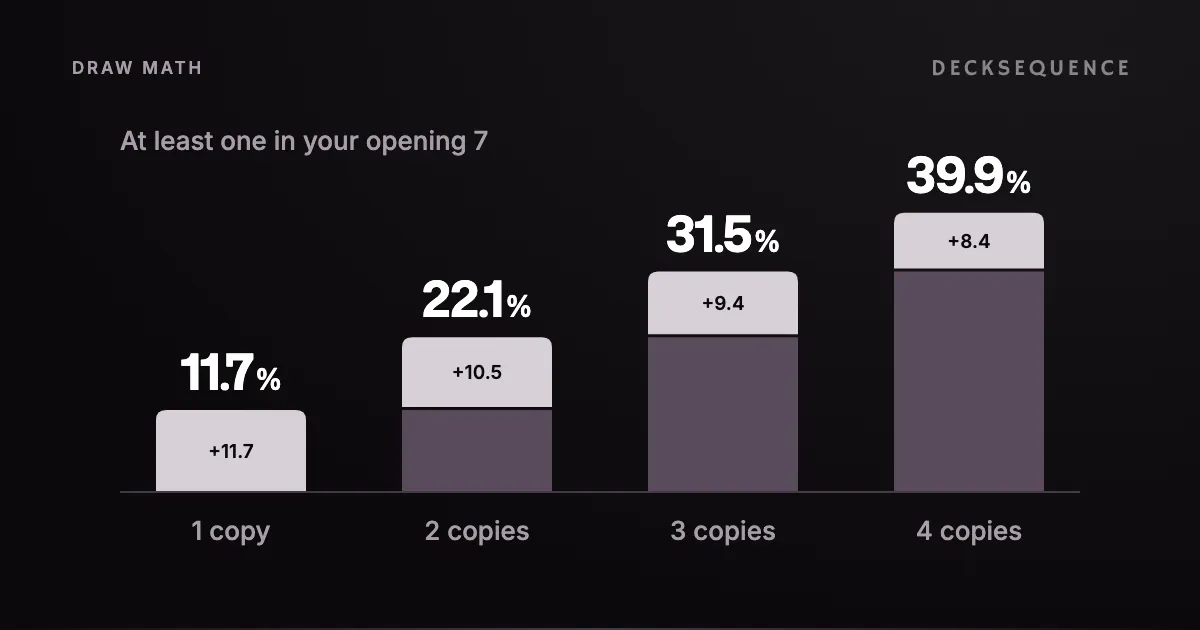
A lot of players reason like this: "4 out of 60 is about 7%, I draw 7 cards, so it's roughly 47%." The real chance of opening at least one of 4 copies is 39.9%.
The shortcut treats every draw as if it came from a full deck, so hands with two or three copies get counted more than once. The error gets bigger as the numbers go up. Try it on a card you run 9 copies of and it comes out at 105%. The real figure is 70.0%.
Each copy adds less
Here's the chance of having at least one copy of a card in your opening hand:
| Copies in your deck | In your opening 7 | Added by this copy |
|---|---|---|
| 1 | 11.7% | +11.7 points |
| 2 | 22.1% | +10.5 points |
| 3 | 31.5% | +9.4 points |
| 4 | 39.9% | +8.4 points |
The last column is the one to look at. The second copy adds 10.5 points, and the fourth only 8.4 points. If a card only needs to turn up by the midgame, two or three copies plus your draw engine is often enough, and the slot you save can go somewhere it matters more.
To answer that for a specific card in your own list, add it as a query on your deck's Odds page in DeckSequence and read off its odds by turn.
Basics are a special case
For a Basic Pokémon, the opening-hand number above is too low. A hand without a Basic always gets shuffled back and redrawn, so every hand you actually keep has at least one Basic in it. In a deck with 10 Basics, a 4-of Basic is in the hand you keep 53.9% of the time, rather than 39.9%. Every query on a deck's Odds page shows this "after mulligans" figure next to the raw one.
Prizes don't change the odds
Getting your key card prized is real and it's frustrating, but it has nothing to do with your opening hand. Prize cards come off the top of your deck only after both players have drawn their hands and placed their Pokémon.
After that, any card you haven't seen could be in your deck or in your Prizes, and you don't know which. A prized card usually only comes back when you take that Prize, so prizing does affect what you can reach later in the game. What it doesn't do is change the odds of what you'll draw next.
Using this when you build
For each card, ask when the deck needs it and what chance of having it by then you're happy with. Grouping the cards that do the same job, like every way you have of finding your main attacker, gives you a far more useful number than looking at one card at a time, and you can set up groups like that as soon as you add a deck to DeckSequence.
The next two articles apply this math to the two places it matters most: how many Basics to run, and what going first or second changes.