


Playing better
Sequencing: which card to play first
DeckSequence · Updated · 5 min read
Two players can hold the same hand and win a different number of games with it, just because one of them played the cards in a better order. Sequencing is the first of the six play disciplines, and getting better at it doesn't cost you a single deck slot.
Don't multiply your odds
Setting up usually needs two things at once, like an attacker and an Energy. Players who know basic draw math often work out each chance on its own and multiply them. That gives the wrong answer, because the two requirements are competing for the same slots in your hand.
Take a deck with 9 attacker copies and 10 Energy, by your first turn (8 cards seen, whichever seat you're in). The chance of an attacker is 75.1% and the chance of an Energy is 79.0%. Multiplying gives 59.4%, but the real chance of having both is 57.9%. The gap is small here, but multiplying always overstates your odds when two requirements compete for the same 8 cards, and the error grows with tighter combos.
Combo odds on a deck's Odds page in DeckSequence do this properly. Set your attackers as one condition and your Energy as another, and you get the chance of having both, with an "after mulligans" figure next to it.
A worked example: which card first?
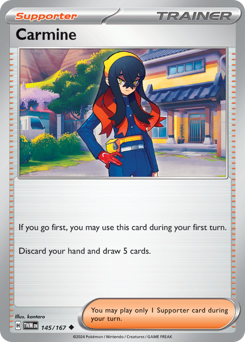
It's your second turn. You haven't attached an Energy this turn and there isn't one in your hand. You've seen 9 cards so far, so 51 are still unseen (your deck plus your face-down Prizes), and 8 of those are Energy. You're holding Buddy-Buddy Poffin and Carmine, which discards your hand and draws 5 cards. Carmine is your Supporter for the turn, since you only get one.
You have two options:
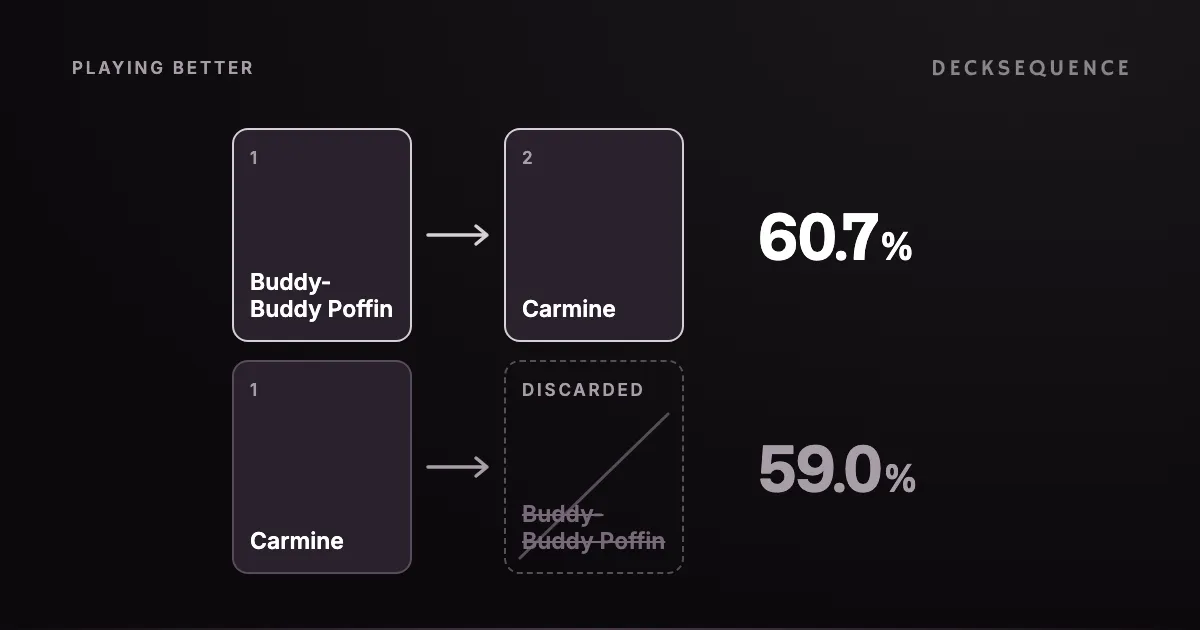
- Play Carmine first. You discard your hand and draw 5, with a 59.0% chance of hitting an Energy. The Poffin you didn't play goes to the discard pile with the rest of your hand.
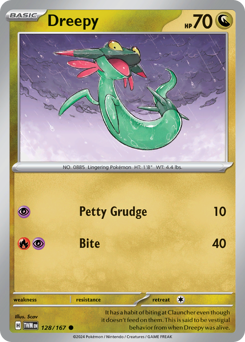
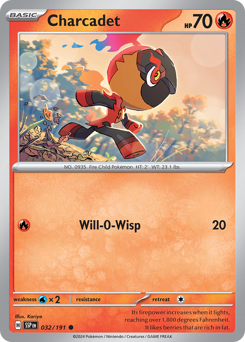
- Play Buddy-Buddy Poffin first. You search out two Basics with 70 HP or less, put them on your Bench and shuffle. That leaves 49 unseen cards with all 8 Energy still among them, so Carmine's 5 cards come from a better pile: 60.7%.
Here are both lines on the replay board DeckSequence builds from PTCG Live battle logs. Switch between them to compare.
 10
10
Hand5


Poffin first is the better line whenever you have room on your Bench. You get to use the Poffin instead of discarding it, two cards you didn't want to draw are gone from the deck, and searching shows you what's actually left in it, including whether any Energy are prized, before you commit to Carmine. The raw difference is 1.7 points, and it costs you nothing.
The general rule
Play your search cards before any Supporter that discards or shuffles away your hand, search out the cards you'd rather not draw into, and draw last. A discard-and-draw Supporter like Carmine throws away whatever you haven't played. A shuffle-and-draw one like Lillie's Determination puts it back in your deck instead, which wastes less, but you still lose the chance to use it this turn. Searching first also shows you what you're working with, and every card you take out of the deck makes every later draw a little better.
It adds up
A single sequencing decision rarely decides a game on its own. Across a tournament, though, you make hundreds of them, so a habit that's slightly better every turn is worth a real number of games by the end.
The hard part is noticing your own habits, because few players remember the order they played a turn in. Paste your battle logs into DeckSequence and each game becomes a replay you can step through, so you can check whether you searched before you drew. Sign up to start reviewing your own games.