

Tournaments
Using a competitive Pokémon TCG decklist before your next event
By Johnnie Tirado
Founder of DeckSequence and competitive Pokémon TCG player.
· 6 min read
Before you play a competitive Pokémon TCG deck, check what the 60 does on its own. DeckSequence publishes the full lists from Worlds 2026 and this season's Regionals, each with its mulligan rate and opening-hand odds: Andrew Hedrick's Puebla-winning Dragapult, for one, has 11 Basic Pokémon and mulligans 22.2% of the time.
Then deal it a few opening hands, copy it into your own decks, and change it there, so every edit shows you its new odds before you test it. Here's what each list page shows, the numbers worked through on Hedrick's list, and how the copy works.
What a list page shows
Competitive decklists groups published lists by event, from Worlds 2026 to the latest Regionals, with a link to each deck's hub. A list page has four parts:
- The 60. Every card with its count, which you can switch to a view grouped by Pokémon, Trainers and Energy. Copy deck list puts it on your clipboard as a PTCG Live export.
- Deck consistency. The mulligan rate and the Basic Pokémon count, then the chance your opening 7 holds at least one Basic Pokémon, one Supporter and one Energy. These are worked out from the card counts, not from a sample of games.
- Deal an opening hand. Seven cards off the top of that exact list, dealt again each time you press Draw again, with a running count of hands and mulligans.
- Use this deck. The button that copies the list into your own decks, covered below.
The header has the placement, the event, the date and the record, and the footer credits the player and links to the source of the standings. A deck hub, such as Dragapult, puts every published list of one deck side by side, grouped by event, with the range of mulligan rates and Basic counts across them. That's the place to compare the lists before you pick one.
The worked example: Hedrick's Puebla Dragapult
Andrew Hedrick won the Puebla Regional 14–2–1 with this Dragapult. It is, card for card, the 60 Riley McKay won Louisville with two weeks earlier at 15–0–3, and the Puebla top 8 recap has the rest of its story. The counts that matter here are:
| Group | Cards | Count |
|---|---|---|
| Basic Pokémon | 4 Dreepy, 2 Budew, 2 Munkidori, 1 Dunsparce, 1 Fezandipiti ex, 1 Meowth ex | 11 |
| Supporters | 4 Lillie's Determination, 3 Boss's Orders, 2 Crispin, 1 Judge, 1 Rosa's Encouragement | 11 |
| Energy | 3 Darkness, 3 Fire, 3 Psychic | 9 |
From those counts, in a 60-card deck:
- Mulligan: 22.2% of opening hands have no Basic Pokémon. Two in a row happens 4.9% of the time.
- A Supporter in the opening 7: 77.8%. With 11 Supporters and 11 Basics, the two figures are the same.
- An Energy in the opening 7: 70.0%.
- A Dreepy in the opening 7: 39.9%. Since you only ever keep a hand with a Basic in it, the chance a Dreepy is in the hand you actually keep is 51.4%.
The page rounds these to whole numbers, so it shows 22%, 78% and 70%. Four Buddy-Buddy Poffin also put Dreepy into play, so a Dreepy or a Poffin in the opening 7, eight cards between them, comes to 65.4%, and 75.1% by your second turn from draws alone. Draw odds explains how those are worked out.
Now deal ten hands: the first one is dealt when the page loads, then press Draw again nine times. On average that's about two mulligans, but none or four in ten hands is ordinary, so ten hands can't confirm a rate. What they do is show you what a one-in-five mulligan feels like at the table, and which hands with a Basic you would still not want to keep.
What a one-card change does
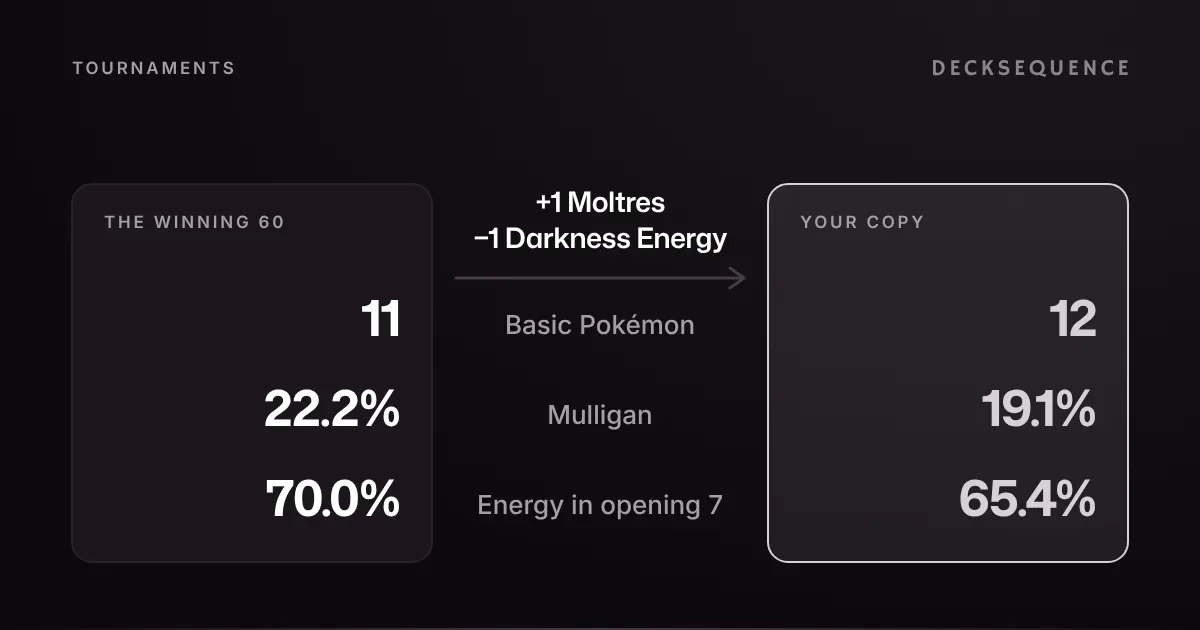
Copying a list is rarely the end of it. Yoshiyuki Yamaguchi took the same 60 with one change to 4th at the same event: a Moltres in place of one Darkness Energy.
That single swap moves the deck to 12 Basic Pokémon and 8 Energy. The mulligan rate drops from 22.2% to 19.1%, and the chance of an Energy in the opening 7 drops from 70.0% to 65.4%. Fewer mulligans, fewer Energy: a trade you can see in numbers before you decide whether Moltres earns its place. The mulligan math article goes further into what each extra Basic buys.
This is where your own copy of the list helps. You make the swap and the odds move with it, instead of you doing the arithmetic on a notepad.
Copying it into your Deck Lab
Copy to my decks at the bottom of a list page takes you to DeckSequence. Copying needs an account: create one, or sign in, and the exact 60 is added to your decks as a new deck of your own. If your account is new, you finish setting it up first and the deck is waiting at the end. Reading the list, the odds and the dealt hands needs no account at all.
The copy is yours to change. In the Deck Lab, an opening-hand panel updates with every change, before you save. Play Hands goes further: the chance of seeing each card by turns 1 to 4, odds for a group of cards that do the same job, odds for a specific combination, and practice hands with a mulligan tally. Opening-hand odds with Play Hands has the details. When you save a change, save it as a new version, so the matches you log stay with the list you actually played. Deck versions explains which option to pick.
If you already have a list you want to bring in, from Limitless or a PTCG Live export, Import a decklist covers pasting it, and pasting an updated list into a deck you already have.
Copying, editing, Play Hands and versions are all free. Pro adds the record and win rate for each version and each matchup, which is what tells you later whether the change helped. Every new account starts with a Pro trial that needs no card (Free vs Pro has the full split).
What the list can't tell you
A top-8 list is a result from one event, or in this case two: the same 60 won Louisville 15–0–3 and Puebla 14–2–1. That says it can win a Regional in those fields. It doesn't say how it does against the decks at your locals, or how it does in your hands, and even 17 rounds at one event is a thin sample for any single matchup.
So copy the list, change what you want, and log what happens. Sign up, then start from the list that won Puebla or any other on the competitive decklists page.