

Beginners
Your first locals: what to bring to a League Challenge and what happens
By Johnnie Tirado
Founder of DeckSequence and competitive Pokémon TCG player.
· 5 min read
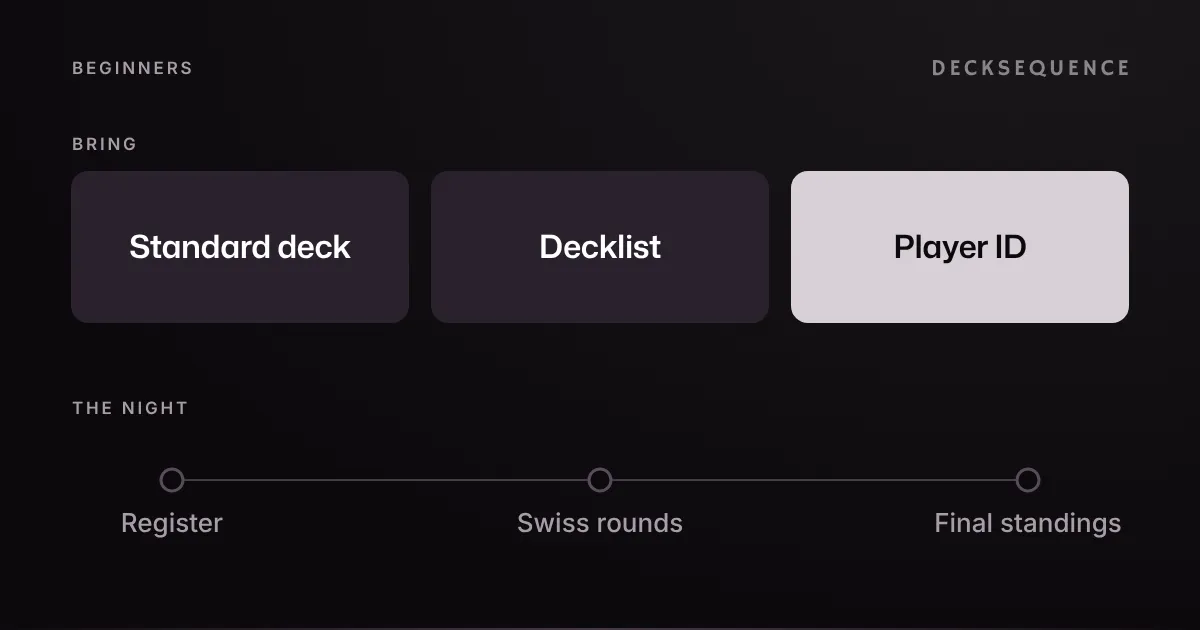
A League Challenge is the monthly, entry-level Play! Pokémon tournament held at eligible local stores, and the first event where your finish earns Championship Points toward a World Championships invitation. To play one in the 2027 season you bring a Standard-legal deck, a complete decklist and a Play! Pokémon Player ID, which you create through a Pokémon Trainer Central account or get from the organizer on the day.
That is the whole barrier to entry. The rest of this page is what each of those means in practice, how the evening runs, and what you have to show for it afterwards.
What is a League Challenge?
A League Challenge is the first tier of the Pokémon Championship Series, the circuit that runs from your local store up to Worlds. Play! Pokémon describes it as the first step before League Cups and Regional Championships. How the events fit together shows all five tiers.
A few things follow from how Challenges are set up:
- Only some stores run them. A store qualifies by reporting its regular league play to Play! Pokémon, so a store with casual nights is not automatically a Challenge store.
- They run in three windows. Championship Point events happen from September to November, December to February and March to May. There are none in June, July or August.
- Look about two weeks out. Organizers are asked to schedule Challenges at least 14 days ahead where they can, so search the Event Locator on play.pokemon.com a couple of weeks before you want to play.
- The prize is mostly the points. Championship Points are the main incentive at a Challenge. The store sets its own prize structure and entry fee, and Play! Pokémon makes no recommendation on the fee. Its Prize Pack FAQ asks stores to give one Prize Pack to each player who attends, with more for the top finishers in each age division.
What a finish is worth, and how many Challenge results count toward your season total, is covered in Championship Points explained.
How do you get a Pokémon Player ID?
A Player ID is the number Play! Pokémon uses to record who attended an event and how they finished. Every competitor needs one, and organizers report attendance by it. You make one through a Pokémon Trainer Central account on pokemon.com:
- Log in to Pokémon Trainer Central.
- Open Play! Pokémon from the menu on the left.
- Choose Create a Play! Pokémon Account and follow the steps until you reach the Player ID step.
- Choose I do not have a Player ID. Your new ID then shows under your name on your account.
If you turn up without one, the organizer can assign you an ID on the day. Afterwards you pick I have a Player ID in the same flow and enter it with its PIN. If the card you were given has no PIN, enter the ID alone once the organizer has reported the event, usually within 5 to 7 days.
Use one ID for good. Knowingly registering a second one breaks Play! Pokémon's terms, and duplicates can be merged or removed without warning. For a child, a parent adds the ID from the child's account, under Play! Pokémon Settings.
Once the store reports the event, it appears on your My Play! Pokémon page.
What to bring to a League Challenge
League Challenges and League Cups are played in the Standard format, and staff can check your deck against your list at any point in the event. That check is the best guide to what you need.
| Bring | Why |
|---|---|
| A 60-card Standard deck | Challenges must be played in Standard |
| A complete, legible decklist | A deck check confirms the deck matches the list exactly |
| Sleeves with no marks, if you use them | A deck check looks for cards or sleeves that could count as marked |
| Your Player ID, and its PIN if you have one | Attendance and results are recorded by Player ID |
| The entry fee | Set by the store |
Add the table kit every game needs: damage counters, a coin, and something to mark Special Conditions. Ask the store ahead of time how it takes decklists.
Filling in the decklist by hand is the slow part. DeckSequence fills in the Play! Pokémon deck registration sheet from your deck and your account details, your name, Player ID and every card, as a PDF to print. For a player under 13, the date of birth is written in by hand. Before you print, it flags anything to fix, like a deck that isn't 60 cards or a card that isn't legal in Standard. The tournament decklist guide walks through it.
What happens on the night
You register with your Player ID and hand in your list. Players are split into three age divisions, Junior, Senior and Masters, by birth year. If one division is small, the organizer can combine divisions for the rounds, and each division still gets its own champion.
A League Challenge is Swiss rounds only, with no top cut. The final standings after the last round decide the placings in each age division. Top cuts start at League Cups. How many rounds, how long each lasts and how ties work is a topic of its own.
Two things surprise first-timers:
- A deck check is routine. Staff confirm the list is complete, the deck is legal and matches it exactly, and nothing is marked. If they ask for yours, wait for their direction before you reorder anything.
- The organizer may be the judge. Play! Pokémon strongly recommends a judge at Challenges and Cups but does not require one. If a ruling comes up, raise your hand and ask. It is normal.
A worked example: one Challenge, logged
Here is a first Challenge as a Masters player might record it: Dragapult ex, four Swiss rounds. The opponents and results are illustrative.
| Round | Opponent deck | Result |
|---|---|---|
| 1 | Alakazam | W |
| 2 | Hydrapple ex | L |
| 3 | N's Zoroark ex | W |
| 4 | Dragapult ex | T |
That is a 2–1–1 evening. The tie counts: it is a round played, not a round skipped.
In DeckSequence this is one Tournament. Start it with the category Challenge, the date, your deck and the Deck Version you registered, and the match type the store announces. Add each round between rounds, which takes a few taps. In the app, rounds save even when the store has no signal. At the end, choose Finish, mark it Completed and add your placement. The round-by-round guide has the steps, and tournaments are free.
What the night tells you is limited. Four matches is a small sample: the loss to Hydrapple ex is one match, not a matchup verdict. A Challenge a month through all three Championship Point windows is nine at one store. Nine logged the same way start to show which matchups you keep losing and which list changes helped. Sign up for DeckSequence before your first Challenge, and the record starts with round 1.