


Beginners
How a tournament runs: Swiss rounds, best of three, time and ties
By Johnnie Tirado
Founder of DeckSequence and competitive Pokémon TCG player.
· 6 min read
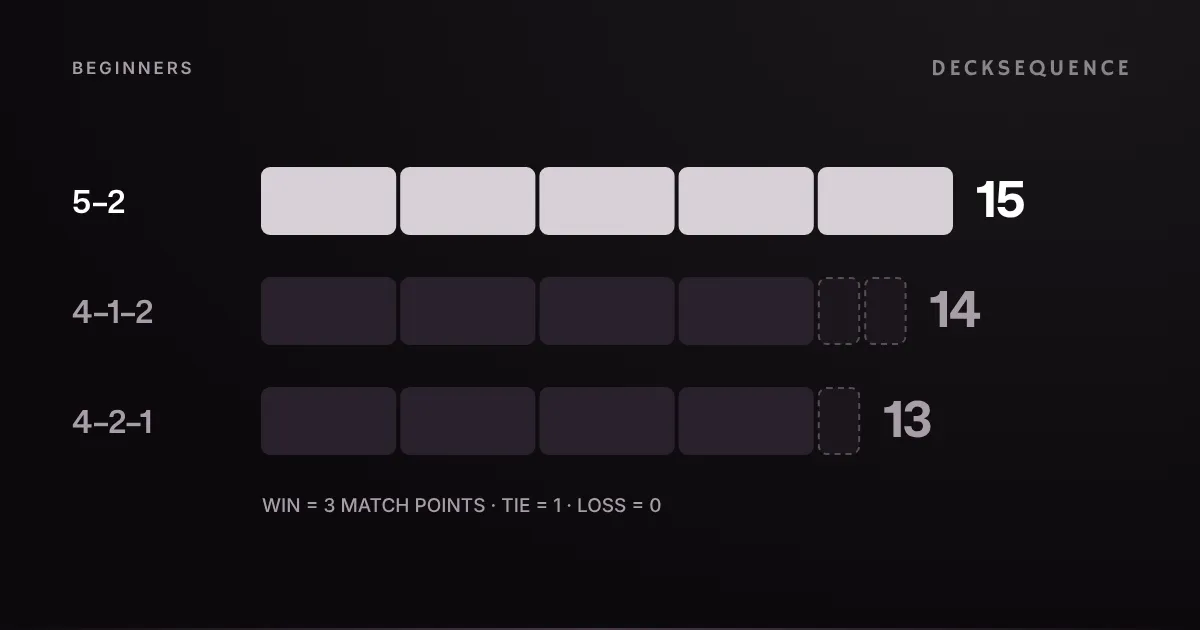
Pokémon TCG tournaments are played in Swiss rounds: each round pairs you with someone on the same record, a win is worth 3 match points, a tie 1 and a loss 0, and the number of rounds grows with the number of players in your age division. Under the current rules, a Swiss match is a single game or best of three at the organizer's choice, every top cut match at a Championship Series event is best of three, and when time is called the game in progress gets three more turns.
The same rules run from a League Challenge at your store up to a Regional. The tiers themselves are in how the events fit together.
How Swiss pairing works
Round 1 is paired at random. From round 2, players are paired at random within their record: the 1–0 players play each other, the 0–1 players play each other, and so on until the set number of rounds is done. Nobody is eliminated during Swiss. You play every round unless you choose to drop.
The number of rounds depends on how many players are in your age division, so a 12-player Cup and a Regional run very different days.
When the player count is odd, someone gets a bye. Byes go to the player with the worst record where possible, and nobody gets more than one in an event. A bye counts as a win on your record, but it is left out when your win percentage is worked out for tiebreakers.
Best of one or best of three
In Swiss, the organizer picks single games or best-of-three matches, and Play! Pokémon recommends best of three at Regionals and above. Single-elimination rounds after Swiss, the top cut, are always best of three at Championship Series events.
In a best-of-three match, a coin flip decides who goes first in game 1, except in the top cut, where the higher seed chooses. After each game, the player who lost it chooses who goes first in the next one.
Store events vary, so it's worth asking at registration. DeckSequence's Tournaments ask the same question when you start one: Best of 1, Best of 3, or Mixed for best-of-one Swiss with a best-of-three top cut.
What happens when time runs out
A game in progress does not stop when time is called. The player whose turn it is finishes it, then the players take three more turns between them, known as +3 turns. At Championship events, those turns run against a 15-minute overtime clock, and the round ends when it runs out. If time is called during Pokémon Checkup, there is no active player, so the next turn is the first of the three.
If nobody has won after those turns, the result depends on where the match was. In Swiss, a match without a winner can be a tie:
| When time is called | Single game | Best of three |
|---|---|---|
| During game 1 | Tie | Tie |
| Between game 1 and game 2, or during game 2 | – | The game 1 winner wins the match |
| Between game 2 and game 3, or during game 3 | – | Tie |
In the top cut a match must have a winner. If time runs out in a single game, or during game 1 or game 3 of a best of three, the player with fewer Prize cards left wins, and if they are level, play goes on until one of them pulls ahead. Between game 1 and game 2, or during game 2, the game 1 winner wins the match. Between game 2 and game 3, a tiebreaker game decides it, and the first player to get ahead on Prize cards wins.
How ties score: a worked example
Match points are what the standings sort by: 3 for a win, 1 for a tie, 0 for a loss. Two players can also agree to an intentional draw, called an ID, and it scores as a tie for both of them.
The arithmetic matters because a tie is worth a third of a win, not half. Two ties earn 2 points. A win and a loss earn 3. Compare three seven-round records:
| Record | From wins | From ties | Total |
|---|---|---|---|
| 5–2 | 5 × 3 = 15 | 0 | 15 |
| 4–1–2 | 4 × 3 = 12 | 2 | 14 |
| 4–2–1 | 4 × 3 = 12 | 1 | 13 |
The 4–1–2 player lost fewer rounds than the 5–2 player and still sits a point behind. The 4–2–1 player is two points behind, the gap between one tie and one win.
Here is a sample nine-round day, scored as it goes:
| Round | Result | Match points so far |
|---|---|---|
| 1 | Win | 3 |
| 2 | Win | 6 |
| 3 | Loss | 6 |
| 4 | Win | 9 |
| 5 | Tie | 10 |
| 6 | Win | 13 |
| 7 | Loss | 13 |
| 8 | Win | 16 |
| 9 | Win | 19 |
That's a 6–2–1 record and 19 match points. A 6–3 record over the same nine rounds is 18, so the round 5 tie, rather than a loss, is the one point between them.
A DeckSequence tournament always shows its record with the ties included, 6–2–1 rather than 6–2, so the match points are one multiplication away for your Swiss rounds: wins times three, plus ties.
Tiebreakers: why your opponents' records matter
Several players usually finish on the same match points. The tiebreaker that decides most standings is Opponents' Win Percentage: the average win percentage of everyone you played. A player's win percentage is their wins divided by rounds played, never below 25%, and never above 75% for a player who dropped. If players are still level, the second tiebreaker is the same average taken one step further out, your opponents' opponents. If exactly two players are still tied and played each other, the winner of that match ranks higher.
Take the 6–2–1 player above, whose nine opponents all played every round:
| Opponent's wins | Wins ÷ 9 rounds | Counts as |
|---|---|---|
| 7 | 78% | 78% |
| 6 | 67% | 67% |
| 5 | 56% | 56% |
| 5 | 56% | 56% |
| 4 | 44% | 44% |
| 3 | 33% | 33% |
| 2 | 22% | 25% |
| 1 | 11% | 25% |
| 0 | 0% | 25% |
The floor lifts the last three to 25%. The average comes to 45%. Without the floor it would be 41%. Your opponents' results keep counting after you've played them, so a strong finish can still lose a tiebreaker to weak early pairings.
Top cut, Day 2, and keeping your own record
After Swiss, each age division gets its own standings, and where the division is big enough, the top players go on to a single-elimination top cut. Big divisions at Regionals, Internationals and Worlds add a second phase of Swiss before the cut, for players who reach a match point threshold, which is what players mean by Day 2. Both the threshold and the size of the cut are set by how many players are in the division.
It's worth keeping your own record. In DeckSequence, a tournament holds every round as you play it, with IDs and byes as their own outcomes, and when it ends you record your placement and how far you got, from Day 2 up to Winner. The round-by-round guide has the steps, and how to log a Regional round by round shows a full day logged that way. Every finish is also a step toward Championship Points. Sign up for DeckSequence and log your next event from round 1.