

Beginners
Preparing for a League Cup in two weeks
By Johnnie Tirado
Founder of DeckSequence and competitive Pokémon TCG player.
· 6 min read
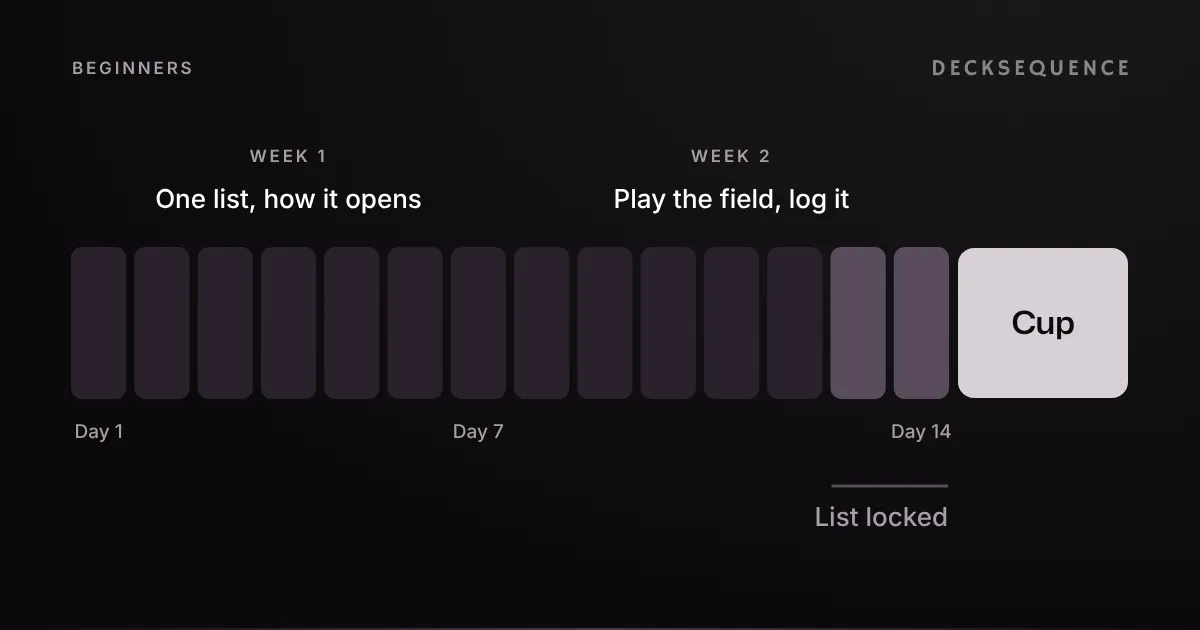
To prepare for a League Cup in two weeks, pick one list in the first few days and stop changing it, spend the first week learning how it opens, and spend the second week playing the decks you expect to face while logging every match. Two weeks is enough to know a deck well and find the problems that show up in most games, but not enough matches to rank your matchups, so plan the time around what it can actually tell you.
A Cup is a step up from a League Challenge: more Championship Points, usually more players, and Swiss rounds and, when a division is big enough, a single-elimination top cut. Where it sits among the other events is in how the events fit together, and what each finish is worth in the 2027 season is in Championship Points explained.
Before day one: the Cup and the format
Find the Cup on the official Event Locator, read its listing, and ask the store anything it doesn't say, like the start time and the format. Store events are normally Standard, the format covered in Standard vs Expanded, but the listing is the one to trust.
Then check the calendar against the set schedule. Delta Reign released on 6 November 2026. New sets are normally legal in Standard from the second Friday after release, which would make Delta Reign legal from 20 November; check the Play! Pokémon legality announcement to confirm. A Cup before that date is played without it. A Cup after it may have new cards in the field, and that changes which week you test what.
Week one: one list, and how it opens
The first decision is the list. For a first Cup, a published list from a recent Regional is a better start than your own build, because the counts have already been through a long event. Take the list you choose and leave it alone for the week. Changing two cards after every bad night means you never learn what the list does.
A worked example: the Dragapult that keeps making top 8
Andrew Hedrick's Dragapult won the Puebla Regional at 14–2–1, and the same 60, card for card, also made top 8 at Louisville, Nice and Gdańsk in other players' hands. Say that's your Cup deck. Its whole plan starts with a Dreepy on the Bench early, so that's the first thing to know about how it opens.
The list runs 11 Basic Pokémon, so it opens with no Basic and has to mulligan 22.2% of the time. It runs 4 Dreepy, so an opening 7 holds one 39.9% of the time before mulligans, and 51.4% of the hands you actually keep. Count the cards that get you a Dreepy, the 4 Dreepy plus 4 Buddy-Buddy Poffin and 3 Ultra Ball, and the opening 7 has at least one of those 11 cards 77.8% of the time before mulligans, or 82.4% once you've drawn for your first turn. That's a draw-only floor: the draw Supporters see more of the deck, so real games do a little better.
Those figures are what week one is for. Deal opening hands to see what a normal start looks like, then play games against a friend or on PTCG Live. If you keep losing games where the hand had a way to Dreepy, the problem is likely how you're playing the opening, not the list. That's the sort of thing two weeks can fix.
DeckSequence works these odds out for your own saved list in Play Hands, and its playtest draw deals opening hands and keeps a tally of mulligans beside the expected rate. The Play Hands guide covers it. Save the list as a deck before you start, so every match in the next two weeks is logged against that exact version.
Week two: play the decks you expect
In week two, play the decks you're most likely to sit across from. Results from the most recent Regionals are a reasonable published guide to a store field. Across the top 8s at Puebla and Gdańsk, Dragapult held 10 of the 16 seats, 6 in Puebla and 4 in Gdańsk. Both events were before Delta Reign, so treat that as a starting point. Whatever your deck, the Dragapult mirror or the Dragapult matchup is the first one to practice.
Log every match as you play it: the opponent's deck, the result, and who went first. A testing night fits in one session, so its record reads as one block afterwards. The sessions guide has the steps.
What 20 matches can tell you
Say three testing nights and some evenings on PTCG Live add up to 20 matches over the two weeks. Here is how far a deck that really wins half its matches can stray from 50% by chance, 95% of the time:
| Games played | Wins, 95% of the time | Win rate it can show |
|---|---|---|
| 10 | 2–8 | 20%–80% |
| 20 | 6–14 | 30%–70% |
| 30 | 10–20 | 33%–67% |
After 20 matches, a deck that truly wins half the time can still show 30% or 70%, and 20 matches is your whole testing block, not 20 against one deck. Even across five matches against one deck, a true 50% matchup goes 4–1 or better 18.8% of the time. So use week two for what it can show you: which matchups feel lopsided in how the games play out, which cards you never get to use, and which opening hands you keep losing with. Leave the win rates for later in the season, once there are enough matches behind them. The small samples article explains the swing.
If week two turns up a change worth making, make it as a new version of the deck, so the matches on the old list stay apart from the new one, and make it before the lock below, not on the morning of the Cup.
The last two days
- Lock the list two days out. No new cards after that. Whatever you didn't test, you don't play.
- Print the decklist. Ask the store whether it wants a deck registration sheet. The sheet takes your name, Player ID and date of birth along with all 60 cards. DeckSequence fills it in from your saved deck and flags anything to fix first, like a card that isn't legal in Standard. The tournament decklist guide has the steps.
- Know how the day runs. Swiss pairings, best of three and what happens at time are in how a tournament runs.
On the day, start a tournament in DeckSequence with the Cup category and add each round as you finish it. The Cup's rounds then sit on the same record as your two weeks of testing, under the same deck version, and the next Cup starts from what this one showed. Sign up for DeckSequence and save your Cup list before your first testing night.