

Beginners
Championship Points explained: how players qualify for Worlds
By Johnnie Tirado
Founder of DeckSequence and competitive Pokémon TCG player.
· 5 min read
Championship Points (CP) are the points Play! Pokémon awards for your finish at Championship Series events, from a League Challenge at your local store up to an International Championship, and they add up over the season toward a World Championships invitation. In the 2027 season there is no fixed qualifying total: a set number of players in each rating zone and age division earn an invitation by where they stand on the Championship Point leaderboard, with 140 Masters invitations each for the USA & Canada and Europe.
Points only count if you have a Pokémon Trainer Central account with a Player ID attached and have opted in to the Play! Pokémon program. Pokémon TCG points are a separate pool from video game and Pokémon GO points, and your running total is on your Pokémon Trainer Central profile page. If the tiers themselves are new to you, start with how the events fit together.
How many Championship Points does each event award?
In the 2027 season, winning a League Challenge is worth 15 Championship Points, a League Cup 50, a Regional or Special Championship 350, and an International Championship 500. Lower finishes pay less, and the bigger the event, the deeper the points go:
| Finish | League Challenge | League Cup | Regional or Special | International |
|---|---|---|---|---|
| 1st | 15 | 50 | 350 | 500 |
| 2nd | 12 | 40 | 325 | 480 |
| 3rd–4th | 10 | 32 | 300 | 420 |
| 5th–8th | 8 | 25 | 280 | 380 |
| 9th–16th | 6 | 20 | 200 | 300 |
| 17th–32nd | 4 | 16 | 160 | 240 |
| 33rd–64th | – | 13 | 120 | 180 |
| 65th–128th | – | – | 80 | 140 |
| 129th–256th | – | – | 60 | 100 |
| 257th–512th | – | – | 45 | 85 |
| 513th–1,024th | – | – | 22 | 42 |
Each placement also has a kicker, the minimum number of players the event needs before that placement pays. Second place needs 4 players at every tier. At a League Cup, 5th–8th needs 17 players, so a 12-player Cup pays points down to 3rd–4th and no further. At a Regional, 9th–16th needs 33. Play! Pokémon notes the values are subject to change, so check the event pages before you plan around a number.
What is the Best Finish Limit?
The Best Finish Limit caps how many results of each kind count toward your total: in 2027, your best 4 League Challenges, your best 4 League Cups, and your best 5 finishes across Regional, Special and International Championships combined. Challenges and Cups each have their own limit. The majors share one, and when a Regional and an International compete for the same slot, the higher point total counts, not the higher placement.
You can play as many events as you like. An extra result only changes your total if it beats one that's already counting. That puts a ceiling on local play: four Challenge wins and four Cup wins come to 260 points, and store events can't add more than that. A single 9th–16th at a Regional is 200, the same as winning four League Cups.
DeckSequence doesn't track Championship Points; your Pokémon Trainer Central profile holds the official total. What it does keep is the finish behind each one. Start a Tournament, pick its category (Challenge, Cup, Regionals, Internationals or Worlds), log each round as you play it, and record your placement when you finish. Every Cup placement is then on record to look up, so you can see which four are counting and what a fifth would have to beat. The round-by-round guide covers the steps.
How do you qualify for Worlds in the 2027 season?
There are two routes to a 2027 World Championships invitation in the Pokémon TCG: finish high enough on your rating zone's Championship Point leaderboard in your age division, or earn a direct invite at a single event. These are the leaderboard invitations per zone:
| Rating zone | Junior | Senior | Masters |
|---|---|---|---|
| USA & Canada | 100 | 100 | 140 |
| Europe | 100 | 100 | 140 |
| Latin America | 75 | 75 | 125 |
| Oceania | 15 | 15 | 20 |
| Middle East & South Africa | 5 | 5 | 10 |
Direct invites go to the winner of each age division at a Regional or Special Championship, the top four in each division at an International Championship, and the top four from the previous season's Worlds, whatever their point totals. They don't pass down: if a player who already has an invite wins again, the runner-up doesn't get one. Players in Japan, South Korea, mainland China and the Asia-Pacific region qualify through their own regions' programs, not through Championship Points.
Your age division decides which leaderboard you're on, and it's set by birth year for the whole season. For 2027, Juniors were born in 2015 or later, Seniors between 2011 and 2014, and Masters in 2010 or earlier.
A worked example: one Masters player's season
Here is a plausible 2027 season for a Masters player in the USA & Canada, scored from the official tables. Every Cup had at least 17 players, and every major was big enough for its placement to pay.
| Event | Finish | Points | Counts? |
|---|---|---|---|
| League Challenge | 1st | 15 | Yes |
| League Challenge | 2nd | 12 | Yes |
| League Challenge | 3rd–4th | 10 | Yes |
| League Challenge | 3rd–4th | 10 | Yes |
| League Challenge | 5th–8th | 8 | No, fifth Challenge |
| League Cup | 1st | 50 | Yes |
| League Cup | 3rd–4th | 32 | Yes |
| League Cup | 5th–8th | 25 | Yes |
| League Cup | 5th–8th | 25 | Yes |
| Regional | 9th–16th | 200 | Yes |
| Regional | 17th–32nd | 160 | Yes |
| International | 65th–128th | 140 | Yes |
| Regional | 33rd–64th | 120 | Yes |
| Regional | 33rd–64th | 120 | Yes |
| Regional | 65th–128th | 80 | No, sixth major |
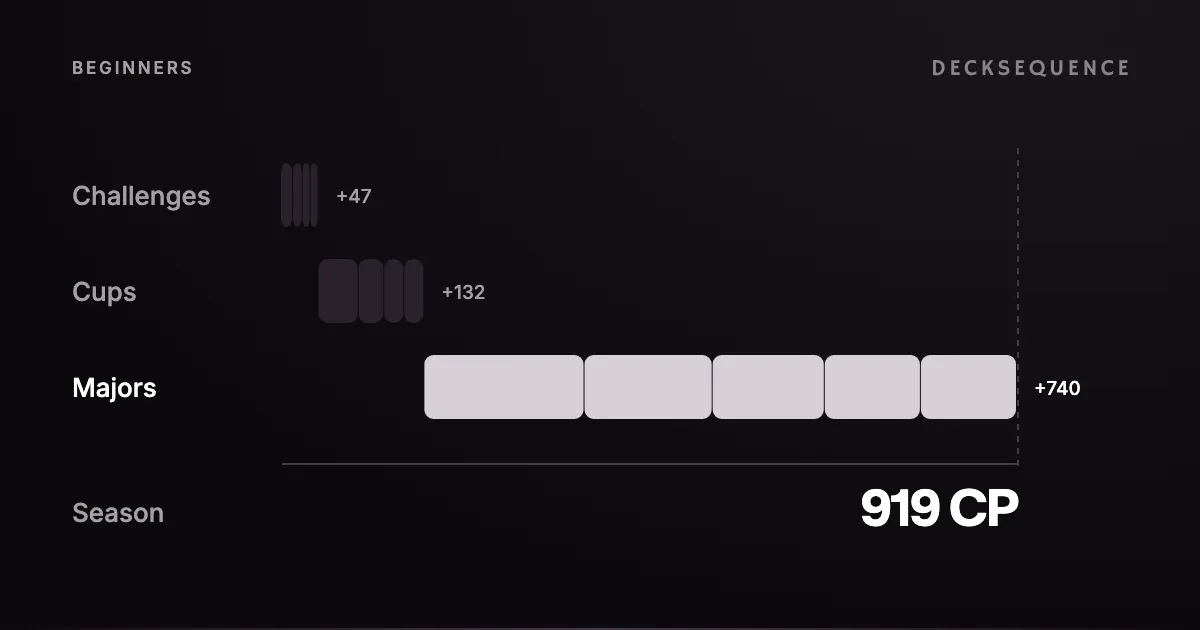
The best four Challenges come to 47 points, the best four Cups to 132, and the best five majors to 740. The season total is 919. Two results drop out under the Best Finish Limit, and of the 919, the majors carry 740.
Whether 919 earns an invitation depends on where it ranks among USA & Canada Masters when the season ends: the top 140 qualify. The official pages publish no target total, so nobody can promise a number in advance. Watch the leaderboard, and remember that a deep Regional run moves you further than another month of store wins.
That table is close to what a DeckSequence Tournaments list looks like by the end of a season: one entry per event, with its category, its rounds and your placement. The points you look up yourself in the official tables. Sign up for DeckSequence and log your next Challenge round by round, so every finish that might count is on record from the start of the season.