

Beginners
Standard vs Expanded, and what regulation marks mean
By Johnnie Tirado
Founder of DeckSequence and competitive Pokémon TCG player.
· 6 min read
Expanded is the Pokémon TCG format with the bigger card pool: it keeps older sets that Standard has rotated out, reaching back to the Black & White era, and it has its own banned list of 27 cards. League Challenges and League Cups must be played in Standard, and its card pool is decided by the regulation mark printed on each card, which right now means H, I and J, plus Basic Energy and reprints.
If you're heading to your first store events, Standard is the one to build for. The rest of this page covers how to read a regulation mark, when a new set becomes legal, and what changes in Expanded, using a real Regional-winning list as the example. It's part of the From locals to Worlds series.
Standard and Expanded side by side
| Standard | Expanded | |
|---|---|---|
| Card pool | Cards marked H, I or J, Basic Energy, and older cards that have a reprint with one of those marks | A much larger pool that keeps older sets, back to the Black & White era |
| Banned cards | None | 27 cards |
| League Challenges and League Cups | Always | Never |
Standard rotates on purpose. Every Championship Series season, older cards leave it, by regulation mark. Expanded keeps far older cards in play, and that bigger pool is where all 27 banned cards sit. Standard has none.
For a store event, the question is settled: League Challenges and League Cups must be played in Standard. For any event above that, read the format on its listing before you build.
What a regulation mark is
A regulation mark is a single letter in the bottom-left corner of a card, printed on cards since 2020. Standard legality is decided by that letter. Before a mark rotates out, a newer mark has already been released to take its place.
In November 2026, Standard is cards marked H, I and J. The 2026 rotation took out G. On Pokémon TCG Live, G cards stopped being legal in Standard on 26 March 2026. The 2026 rotation article has the dates and what left with G.
Three things trip up new players:
- Check the letter, not the set. One set can carry more than one mark. Ascended Heroes reprinted Fezandipiti ex and Night Stretcher with the H mark, for example, so a recent set symbol doesn't tell you which mark a card has.
- Reprints count. An older or unmarked card is legal in Standard if it has been reprinted with a current mark. Your old copy of a reprinted card still works.
- Basic Energy is always legal in Standard, whatever is printed on it. The one exception is Fairy Energy, because the Fairy type was retired.
DeckSequence decides legality from the mark on each printing. The free deck builder only searches Standard-legal cards, and it flags a list that breaks a deck-building rule.
When a new set becomes legal
A new set isn't legal on the day it hits shelves. Delta Reign released on 6 November 2026, and new sets are normally legal in Standard from the second Friday after release, which would make it legal from 20 November. An event in that gap is played without the new cards. DeckSequence reads the mark, not the release date, so it won't flag a new-set card in that gap.
Worked example: reading the marks on a Regional-winning list
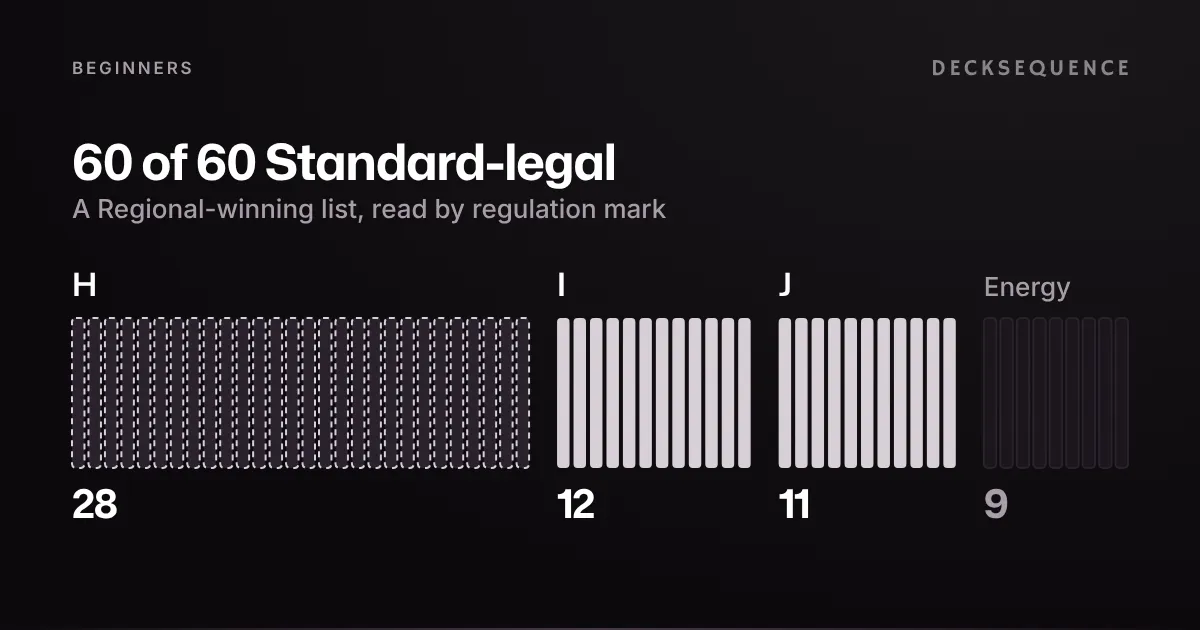
Andrew Hedrick's Dragapult won the Puebla Regional Championships on 24–25 October 2026, at 14–2–1. Here is his 60, grouped by the mark on each printing in the published list:
| Mark | Cards | Copies |
|---|---|---|
| H | 4 Dreepy, 4 Drakloak, 3 Dragapult ex, 2 Munkidori, 2 Budew, 1 Dunsparce, 1 Dudunsparce, 1 Fezandipiti ex, 2 Crispin, 4 Buddy-Buddy Poffin, 3 Night Stretcher, 1 Unfair Stamp | 28 |
| I | 4 Lillie's Determination, 3 Boss's Orders, 3 Ultra Ball, 2 Risky Ruins | 12 |
| J | 1 Meowth ex, 1 Rosa's Encouragement, 1 Judge, 4 Poké Pad, 4 Crushing Hammer | 11 |
| Basic Energy | 3 Fire, 3 Psychic, 3 Darkness | 9 |
| Total | 60 |
Every card is H, I or J, or Basic Energy, so all 60 are Standard-legal today. That's the whole check for most lists: read the letter on each card and make sure it's one of the three.
Reprints are where it gets interesting. Hedrick's Ultra Ball is the I printing from Mega Evolution, but Ultra Ball goes back to the Black & White era. A Dark Explorers Ultra Ball has no mark at all, and it's still legal in Standard because the same card has an I reprint. Crushing Hammer is the same story: his copies are J, from Perfect Order, and an Emerging Powers copy, another Black & White era printing with no mark, works too. His Boss's Orders are I, and a Paldea Evolved copy (printed as Boss's Orders (Ghetsis)), marked G, stays legal for the same reason, even though G itself rotated out.
The table also shows what a rotation does to a list. 28 of the 60 carry H, the oldest legal mark. No 2027 rotation has been announced as of this writing, but if the next one takes H, close to half of this deck goes with it, Dragapult ex included. The rotation article covers which cards on the current top lists have no later printing.
Before a store event, DeckSequence fills in your tournament decklist from your saved deck, and lists anything to fix first under Check before you register, like a card that isn't legal in Standard or a card with no regulation mark on file. It reads the mark of the printing saved in your deck, so if it flags a card you know has a current reprint, switch the deck to the newer printing.
What changes in Expanded
Expanded brings back the cards Standard has dropped, and with them, combinations Standard never sees together. That's what the banned list is for. It names 27 cards, including Shaymin-EX from Roaring Skies, Lysandre's Trump Card, Hex Maniac, Puzzle of Time and Scoop Up Net. The oldest are Black & White cards: Archeops from Noble Victories, Sableye from Dark Explorers and Ghetsis from Plasma Freeze. Standard has no banned cards at all.
Building for Expanded is a different job. A Black & White era card can be the right call, older printings of staples are back in play, and strategies that rotated out of Standard years ago come with them. If your local scene runs an Expanded event, treat it as a separate deck with a separate record, not a variant of your Standard list.
Most of a first season happens in Standard, though, because the store events do. Track that season from the first Challenge: sign up for DeckSequence, add the list you're bringing, and save each change as a new version so a rotation never blends two formats into one record.