


Getting Started
How to play the Pokémon TCG: the rules in one page
By Johnnie Tirado
Founder of DeckSequence and competitive Pokémon TCG player.
· 4 min read
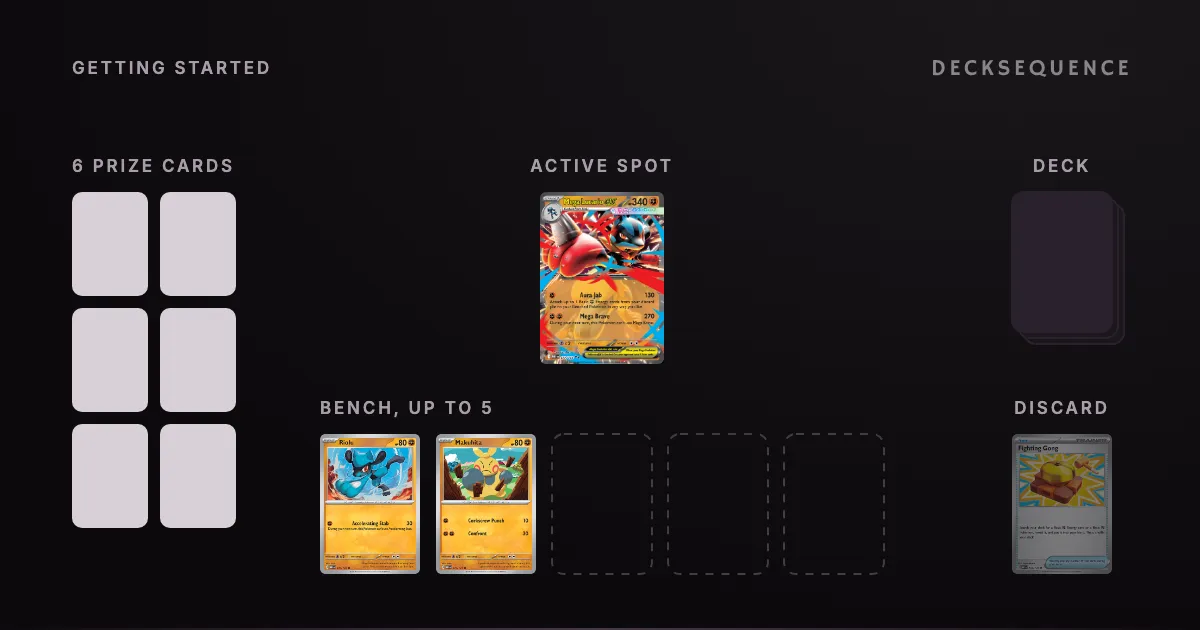
In the Pokémon TCG, two players each bring a 60-card deck and take turns attacking each other's Pokémon, and the first player to take all 6 of their Prize cards wins. You also win if your opponent has no Pokémon left in play, or has no cards left to draw at the start of their turn.
What is the Pokémon TCG?
The Pokémon Trading Card Game is played between two players with a deck of exactly 60 cards each. A deck can hold at most 4 copies of any card with the same name, except Basic Energy, which is unlimited. It needs at least 1 Basic Pokémon, and can include at most 1 ACE SPEC card.
There are three kinds of card:
| Card type | What it does |
|---|---|
| Pokémon | Your attackers. Basics go straight into play; a Stage 1 evolves from a Basic, a Stage 2 from a Stage 1. |
| Energy | Attached to Pokémon to pay for attacks. |
| Trainer | Items, Supporters, Stadiums and Pokémon Tools. |
Pokémon ex have more HP and stronger attacks than regular Pokémon, and give up more Prize cards when Knocked Out.
What is on the playmat?
Each player has six areas:
| Area | What goes there |
|---|---|
| Active Spot | Your one Active Pokémon, the one that attacks. You must always have one. |
| Bench | Up to 5 more Pokémon waiting to come in. |
| Hand | Your cards, hidden from your opponent. You start with 7. |
| Deck | Face down. Nobody looks through it unless a card says so. |
| Prize cards | 6 cards set aside face down from the top of your deck at setup. |
| Discard pile | Knocked Out Pokémon, used Trainers and discarded Energy. |
How do you set up a game?
You flip a coin for who goes first, draw 7 cards, and put a Basic Pokémon face down in the Active Spot.
- Flip a coin. The winner decides who goes first.
- Shuffle your deck and draw 7 cards.
- Put one Basic Pokémon face down as your Active Pokémon.
- Put up to 5 more Basic Pokémon face down on your Bench.
- Set the top 6 cards of your deck aside face down as your Prize cards.
- Flip your Pokémon face up and start.
No Basic Pokémon in your 7 is a mulligan: reveal, shuffle back, draw 7 again. Your opponent may draw a card for each extra mulligan you take. Setup, mulligans and the first-turn rules covers every case. Play Hands in DeckSequence shows the mulligan chance for your own list from its exact card counts, and the mulligan math explains the number.
What can you do on your turn?
Every turn starts with a draw. Both players draw every turn, including the first.
Then you can take any of these actions, in any order:
- Put Basic Pokémon from your hand onto your Bench, up to 5 there.
- Evolve Pokémon that have been in play since the start of your turn, each once per turn.
- Attach one Energy card per turn from your hand to one of your Pokémon.
- Play Trainer cards: any number of Items and Pokémon Tools, but only one Supporter and one Stadium per turn.
- Retreat your Active Pokémon once: discard Energy attached to it equal to its Retreat Cost and swap it with a Benched Pokémon. You can still attack afterward. An Asleep or Paralyzed Pokémon can't retreat.
- Use Abilities, from the Active Spot or the Bench. Abilities are not attacks.
Last, you may attack with your Active Pokémon, and attacking ends your turn. Attacking is optional.
Between turns comes the Pokémon Checkup, where Special Conditions such as Poisoned and Burned do their damage. Special Conditions explained covers all five.
How does attacking work?
To attack, your Active Pokémon needs the Energy in the attack's cost attached to it. Any type of Energy pays for a Colorless symbol.
Damage is tracked with damage counters, one for every 10 damage. If the Defending Pokémon has Weakness to your attacker's type, current cards double the damage, so 30 becomes 60. Resistance reduces the damage by the number printed on the Defending Pokémon's card. Weakness and Resistance apply only to the Active Pokémon. A Pokémon with damage equal to or more than its HP is Knocked Out and discarded with everything attached.
Each Knock Out lets the attacker take Prize cards into their hand: 1 for most Pokémon, 2 for a Pokémon ex, 3 for a Mega Evolution Pokémon ex. Its owner then promotes a new Active Pokémon from the Bench. How Prize cards work goes through the trades.
What can't you do on your first turn?
Going first, you can't attack or play a Supporter on your first turn, but you still draw. Neither player can evolve on their own first turn, and no Pokémon evolves on the turn it came into play. Going first vs. going second looks at what that trade is worth.
Hand0
A full game, turn by turn
This is a whole game, Mega Lucario ex against Mega Venusaur ex, from the coin flip to the last Prize card. Press play, or step through it from either player's side.
Mega Lucario ex vs Mega Venusaur ex
Alex won on Prize cards
Your hand (0)
empty
The full battle log, turn by turn
Setup
- Setup
- Bea chose tails
- Alex won the coin toss
- Alex goes first
- Alex drew opening hand
- Bea drew opening hand
- Alex played Riolu (Active)
- Alex played Makuhita (Bench)
- Bea played Bulbasaur (Active)
- Bea played Chikorita (Bench)
- Bea played Teal Mask Ogerpon ex (Bench)
Turn 1: Alex
- Alex's turn
- Alex drew Mega Lucario ex
- Alex played Fighting Gong
- Alex played Riolu (Bench)
- Alex attached Basic Fighting Energy to Riolu
- Alex ended their turn
Turn 2: Bea
- Bea's turn
- Bea drew a card
- Bea played Lillie's Determination
- Teal Mask Ogerpon ex used Teal Dance
- Bea played Bulbasaur (Bench)
- Bea attached Basic Grass Energy to Bulbasaur
- Bea ended their turn
Turn 3: Alex
- Alex's turn
- Alex drew Basic Fighting Energy
- Riolu → Mega Lucario ex
- Alex attached Basic Fighting Energy to Mega Lucario ex
- Alex played Lillie's Determination
- Alex played Ultra Ball
- Mega Lucario ex used Aura Jab (130 dmg)
- Bulbasaur was knocked out
- Alex took 1 prize
- Basic Fighting Energy added to Alex's hand
- Teal Mask Ogerpon ex is now active
Turn 4: Bea
- Bea's turn
- Bea drew a card
- Teal Mask Ogerpon ex used Teal Dance
- Bea attached Basic Grass Energy to Teal Mask Ogerpon ex
- Bulbasaur → Ivysaur
- Chikorita → Bayleef
- Teal Mask Ogerpon ex used Myriad Leaf Shower (180 dmg)
Turn 5: Alex
- Alex's turn
- Alex drew Ultra Ball
- Alex attached Basic Fighting Energy to Riolu
- Mega Lucario ex used Mega Brave (270 dmg)
- Teal Mask Ogerpon ex was knocked out
- Alex took 2 prizes
- Lillie's Determination added to Alex's hand
- Makuhita added to Alex's hand
- Ivysaur is now active
Turn 6: Bea
- Bea's turn
- Bea drew a card
- Ivysaur → Mega Venusaur ex
- Bayleef → Meganium
- Bea attached Basic Grass Energy to Mega Venusaur ex
- Mega Venusaur ex used Jungle Dump (240 dmg)
- Mega Lucario ex was knocked out
- Bea took 3 prizes
- Basic Grass Energy added to Bea's hand
- Ivysaur added to Bea's hand
- Ultra Ball added to Bea's hand
- Riolu is now active
Turn 7: Alex
- Alex's turn
- Alex drew Basic Fighting Energy
- Alex attached Basic Fighting Energy to Makuhita
- Alex played Switch
- Makuhita is now active
- Makuhita → Hariyama
- Riolu → Mega Lucario ex
- Alex played Riolu (Bench)
- Alex played Makuhita (Bench)
- Hariyama used Wild Press (210 dmg)
Turn 8: Bea
- Bea's turn
- Bea drew a card
- Bea attached Basic Grass Energy to Mega Venusaur ex
- Mega Venusaur ex used Jungle Dump (240 dmg)
- Hariyama was knocked out
- Bea took 1 prize
- Lillie's Determination added to Bea's hand
- Mega Lucario ex is now active
Turn 9: Alex
- Alex's turn
- Alex drew Switch
- Alex played Fighting Gong
- Alex attached Basic Fighting Energy to Mega Lucario ex
- Mega Lucario ex used Mega Brave (270 dmg)
- Mega Venusaur ex was knocked out
- Alex took 3 prizes
- Ultra Ball added to Alex's hand
- Riolu added to Alex's hand
- Basic Fighting Energy added to Alex's hand
- All Prize cards taken. Alex wins
The board above is the replay player from DeckSequence. Paste the battle log from one of your own PTCG Live matches and it builds the same thing for that match, turn by turn.
How do you win the Pokémon TCG?
You win the moment one of these happens:
- You take your last Prize card.
- Your opponent has no Pokémon to put in the Active Spot after a Knock Out.
- Your opponent has no cards in their deck at the start of their turn, so they can't draw.
If a card tells you to draw more cards than you have left, you draw what's left and keep playing. If both players win at the same time, they play a short tiebreaker game. The exception: if you win two ways at once and your opponent wins only one, you win.
Each match you log in DeckSequence keeps who went first and the Prize cards each player had left. Sign up for DeckSequence and log the first one.
To watch a game set up and played, the official video takes under five minutes. Next: setup, mulligans and the first-turn rules.