


Getting Started
Pokémon TCG Special Conditions: Asleep, Burned, Confused, Paralyzed and Poisoned
By Johnnie Tirado
Founder of DeckSequence and competitive Pokémon TCG player.
· 5 min read
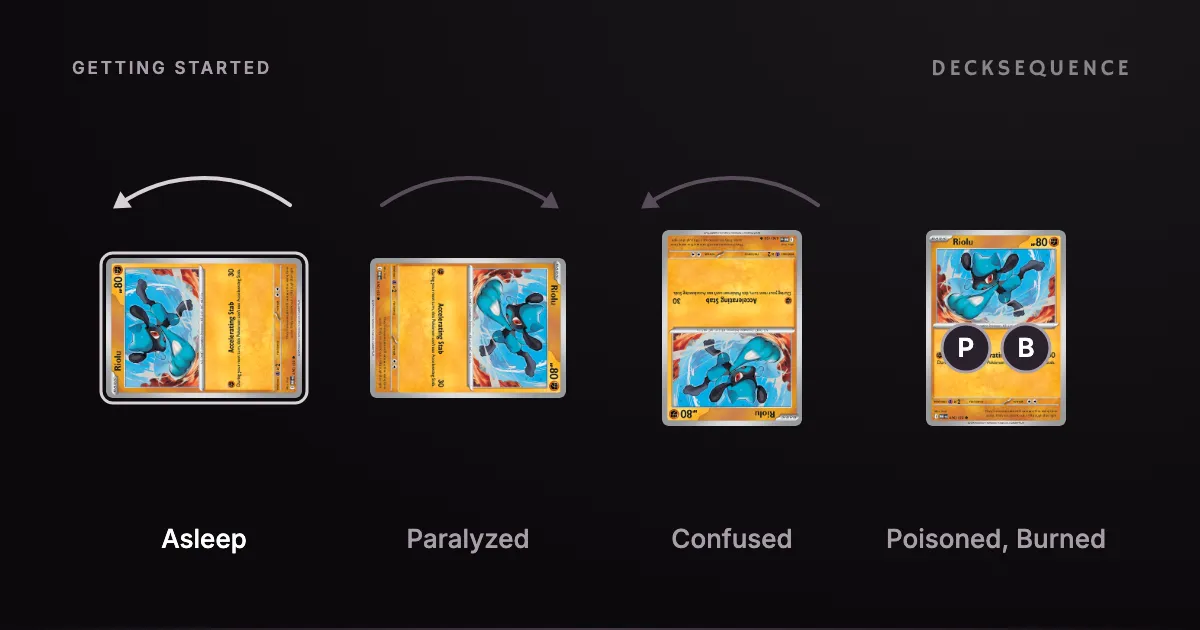
An Asleep Pokémon in the Pokémon TCG is turned counterclockwise, can't attack or retreat, and wakes up when its owner flips heads during Pokémon Checkup. Asleep is one of five Special Conditions, along with Burned, Confused, Paralyzed and Poisoned, and only an Active Pokémon can have them.
Your Active Pokémon is the one in the Active Spot, facing your opponent. Pokémon Checkup is the step between every turn, yours and your opponent's, where Special Conditions put their damage counters and get their coin flips. A Pokémon on your Bench, the row of up to 5 behind the Active Spot, can't have a Special Condition at all, which is how most of them get cured. If you're still learning the turn itself, start with how to play the Pokémon TCG.
What do the five Special Conditions do?
Each one limits what your Pokémon can do, puts damage counters on it, or both. A damage counter is 10 damage.
| Condition | How you show it | What it does | When it ends by itself |
|---|---|---|---|
| Asleep | Turn the card counterclockwise | Can't attack or retreat | Flip at each Checkup, heads wakes it |
| Burned | Burn marker | 2 damage counters at each Checkup | Flip after the damage, heads removes it |
| Confused | Turn the card so its top faces you | Flip before attacking; tails, the attack fails and it takes 3 damage counters | Never |
| Paralyzed | Turn the card clockwise | Can't attack or retreat | At the Checkup after its owner's next turn |
| Poisoned | Poison marker | 1 damage counter at each Checkup | Never |
Every one of them also ends when the Pokémon moves to the Bench or evolves.
How does Asleep work?
An Asleep Pokémon can't attack or retreat, and at every Pokémon Checkup its owner flips a coin: heads wakes it up, tails leaves it Asleep. When your opponent's attack puts it to sleep, the first flip comes at the Checkup right after that attack, before your turn, so it has a 50% chance of waking before it ever misses an attack. On tails it sleeps through your turn, and the next flip comes at the Checkup after that. A Pokémon that puts itself to sleep, like Snorlax with Collapse, gets a flip after your own turn and another after your opponent's, before your next turn.
Mega Froslass ex's Absolute Snow puts the opponent's Active Pokémon to sleep. The usual ways out on your own turn: evolve the sleeping Pokémon, or play an Item such as Switch, which swaps your Active Pokémon with one of your Benched Pokémon.
What do Burned and Poisoned do?
Poisoned puts 1 damage counter on the Pokémon at every Checkup until it's cured. Burned puts 2 damage counters on it at every Checkup, and then its owner flips a coin and removes the Burn marker on heads.
A Pokémon holds only one Poison marker and one Burn marker, so being Poisoned twice changes nothing. Some cards raise the number instead: Crobat's Poison Fang leaves a Poison that puts 2 damage counters per Checkup instead of 1.
Which Special Conditions can stack?
Burned and Poisoned stack with each other and with any one of the other three. Asleep, Confused and Paralyzed all work by turning the card, so a Pokémon can have only one of them, and the newest replaces the old one. A Pokémon can be Burned, Poisoned and Paralyzed at the same time. Erika's Vileplume ex's Bloom Powder, for one, leaves the opponent's Active Pokémon Asleep and Poisoned.
What order does Pokémon Checkup go in?
Checkup resolves Special Conditions in a fixed order: Poisoned, then Burned, then Asleep, then Paralyzed. Any Pokémon Knocked Out by that damage is dealt with after all four are done.
How much damage do Burned and Poisoned do together?
Together they put 3 damage counters, 30 damage, on a Pokémon at every Checkup, until a heads takes the Burn away. Here is one played out on Riolu, an 80 HP Basic Pokémon with a Retreat Cost of 2 that evolves into Mega Lucario ex.
- Your opponent's Tangela uses Poison Powder, and your Active Riolu is Poisoned. Checkup puts 1 damage counter on it: 70 HP left.
- Your turn. You have no Switch, no Mega Lucario ex and not enough Energy to retreat, so Riolu attacks and stays where it is. Checkup puts on a second counter: 60 HP left.
- Your opponent plays Switch to bring Vulpix into the Active Spot, and Vulpix uses Singe. Riolu is now Burned as well as Poisoned. Checkup goes Poisoned first (1 counter), then Burned (2 counters): 5 counters in all, 30 HP left. Then the Burn flip.
- Heads: the Burn marker comes off. Riolu is still Poisoned, with 30 HP left.
- Tails: Riolu stays Burned and Poisoned. If it is still Active at the next Checkup, that's 3 more counters, 8 in all, and Riolu is Knocked Out.
- Your turn. Draw Mega Lucario ex and evolve, and both conditions end at once. The damage stays: Mega Lucario ex has 340 HP, so with 5 counters it has 290 left.
Once you're playing on PTCG Live, paste a match's battle log into DeckSequence and step through it turn by turn, with the Prizes each player had left saved beside it. Sign up for DeckSequence and log the next one.
How do you cure a Special Condition?
Move the Pokémon to the Bench or evolve it: either one removes every Special Condition and marker at once, and the damage counters stay. Retreating works for Burned, Confused and Poisoned Pokémon. To clear Asleep and Paralyzed on your own turn, you need a card that moves them, such as Switch, or an evolution. Otherwise an Asleep Pokémon can still wake on heads, and Paralyzed wears off by itself.
Confused has no Checkup flip, so like Poisoned it never wears off by itself. A Confused Pokémon left Active flips before every attack, and on tails the attack fails and it puts 3 damage counters on itself. Retreat it if you can pay the Retreat Cost, or evolve it.
If your deck plays Switch for exactly these turns, Play Hands in DeckSequence shows your chance of having seen at least one by each of your first four turns, worked out from your list's own counts.
Next, see how to build a consistent Pokémon TCG deck.