


Getting Started
Pokémon TCG setup: how to start a game, mulligans and the first turn
By Johnnie Tirado
Founder of DeckSequence and competitive Pokémon TCG player.
· 5 min read
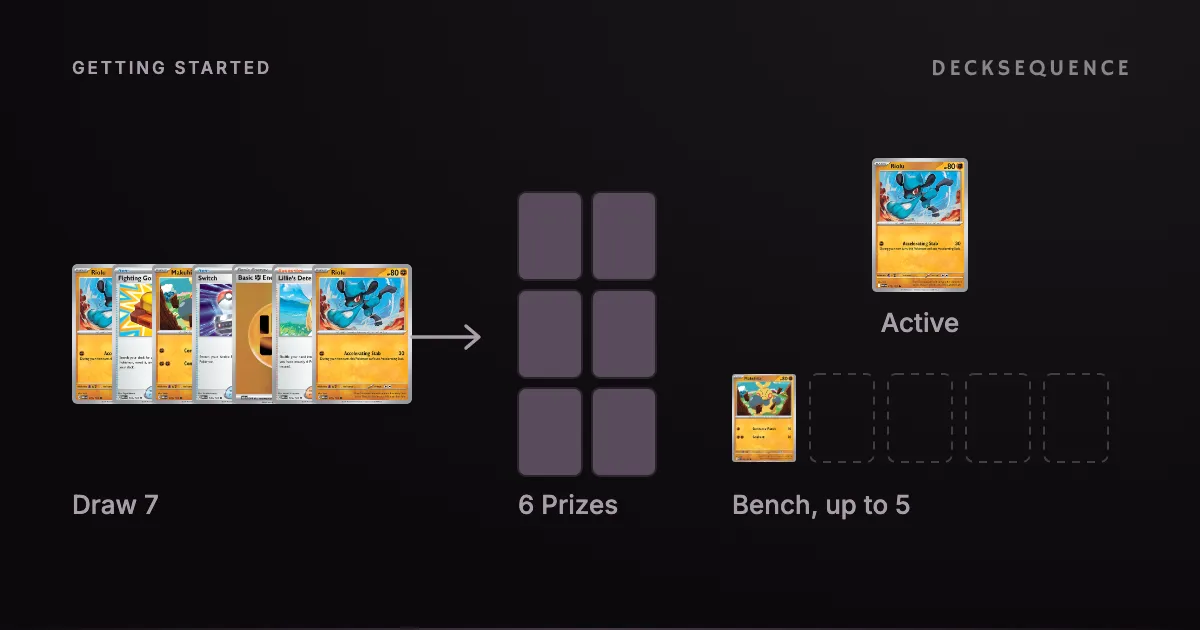
In the Pokémon TCG you start with 7 cards: shuffle your 60-card deck, draw 7, put one Basic Pokémon face down in the Active Spot and up to 5 more on your Bench, then set the top 6 cards of your deck aside as Prize cards. If your 7 cards have no Basic Pokémon, you mulligan: reveal the hand, shuffle it back, draw 7 again, and your opponent may draw 1 extra card for each extra mulligan you took.
A Basic Pokémon is one that doesn't evolve from anything, so it can be put into play straight from your hand. The Active Spot holds the one Pokémon that attacks and gets attacked. The Bench holds up to 5 more that wait their turn. If you're new to the game as a whole, how to play the Pokémon TCG covers the rest of a turn.
How do you set up a game of Pokémon TCG?
Setup takes eight steps, and both players do them at the same time:
- Shake hands with your opponent.
- Flip a coin. The winner decides who goes first.
- Shuffle your 60-card deck and draw 7 cards.
- Check your hand for a Basic Pokémon. No Basic means a mulligan (next section).
- Put one Basic Pokémon face down in the Active Spot.
- Put up to 5 more Basic Pokémon face down on your Bench, if you want to.
- Put the top 6 cards of your deck face down to one side, without looking at them. These are your Prize cards.
- Both players flip their Active and Benched Pokémon face up, and the game starts.
You take 1 Prize card into your hand each time you Knock Out one of your opponent's Pokémon (2 for a Pokémon ex, 3 for a Mega Evolution Pokémon ex), and taking your last one wins the game. Benching at setup is optional: Basics you hold back can come down on a later turn.
How many cards do you start with?
You start with 7 cards in your hand and 6 Prize cards, which leaves 47 cards in your deck before anyone takes a turn. Every Basic you put in play at setup comes out of those 7, so a player who opens with a Basic in the Active Spot and one on the Bench holds 5 cards before their first draw.
What happens if you have no Basic Pokémon?
You mulligan: reveal your hand, shuffle it back and draw 7 again, as many times as it takes to find a Basic.
If only one player mulligans, they say so and wait while the other player finishes setting up. The other player may then draw 1 card for each extra mulligan the opponent took. That's mulligans beyond their own: if both players mulliganed twice and one of them took 3 more, the other may draw up to 3. Any Basic Pokémon drawn this way can go onto the Bench. If neither player has a Basic, both reveal their hands and start setup over, with no extra cards for anyone.
How often this happens depends on how many Basics your deck runs. A deck with 12 Basics mulligans in 19.1% of its games, and two times in a row in 3.6%. Mulligan math has the rate for every common Basic count. For your own list, add it to DeckSequence and open Play Hands, which is free and works the mulligan chance out from the deck's exact card counts.
A full setup, played out
Alex plays a Mega Lucario ex deck. Bea plays Mega Venusaur ex. Alex wins the coin flip and chooses to go second, so Bea goes first.
Alex draws 7: Riolu, Makuhita, Fighting Gong, Lillie's Determination, Switch and 2 Basic Fighting Energy. Riolu goes face down in the Active Spot and Makuhita onto the Bench.
Bea's 7 have no Basic, and neither do her next 7. Her third hand has Bulbasaur and Chikorita. She took 2 mulligans and Alex took none, so Alex may draw 2 extra cards. They're a second Riolu and a Basic Fighting Energy, and the Riolu goes on his Bench.
Both players set 6 Prize cards aside and flip their Pokémon. Here's where everything sits:
| Alex | Bea | |
|---|---|---|
| Active Spot | Riolu | Bulbasaur |
| Bench | Makuhita, Riolu | Chikorita |
| Hand | 6 cards | 5 cards |
| Prize cards | 6 | 6 |
| Deck | 45 cards | 47 cards |
Each column adds up to 60. Alex's deck is 2 cards lighter because of his extra draws.
Bea's first turn: she draws a card and attaches a Grass Energy to Bulbasaur. She can't play a Supporter or attack, because she went first, and she can't evolve Bulbasaur into Ivysaur, because nobody evolves on their own first turn.
Alex's first turn: he draws, attaches a Fighting Energy to the Active Riolu, then plays Lillie's Determination. It shuffles his hand into his deck and draws 6, or 8 while he still has all 6 Prize cards, so Alex draws 8. Riolu attacks Bulbasaur with Accelerating Stab for 30 damage, 3 damage counters on an 80 HP Pokémon. Riolu can't evolve into Mega Lucario ex until Alex's next turn.
Hand0
What can each player do on the first turn?
Both players draw at the start of their first turn. The player going first can't play a Supporter or attack that turn, and neither player can evolve on their own first turn:
| On your first turn | Going first | Going second |
|---|---|---|
| Draw a card | Yes | Yes |
| Bench Basic Pokémon | Yes | Yes |
| Attach one Energy | Yes | Yes |
| Play Items and Pokémon Tools | Yes | Yes |
| Play a Supporter | No | Yes |
| Attack | No | Yes |
| Retreat | Yes | Yes |
| Play a Stadium | Yes | Yes |
| Use Abilities | Yes | Yes |
| Evolve | No | No |
A card can override any of these if its text says so. Going first vs. second goes through which seat suits which kind of deck.
A match logged in DeckSequence keeps who went first beside the result and the Prize cards left, and for a PTCG Live match the pasted battle log becomes a replay you can step through turn by turn.
Next in this series: Prize cards, how many you take and why ex give up 2.