


Playing better
The six disciplines: what your games say about your play
DeckSequence · Updated · 6 min read
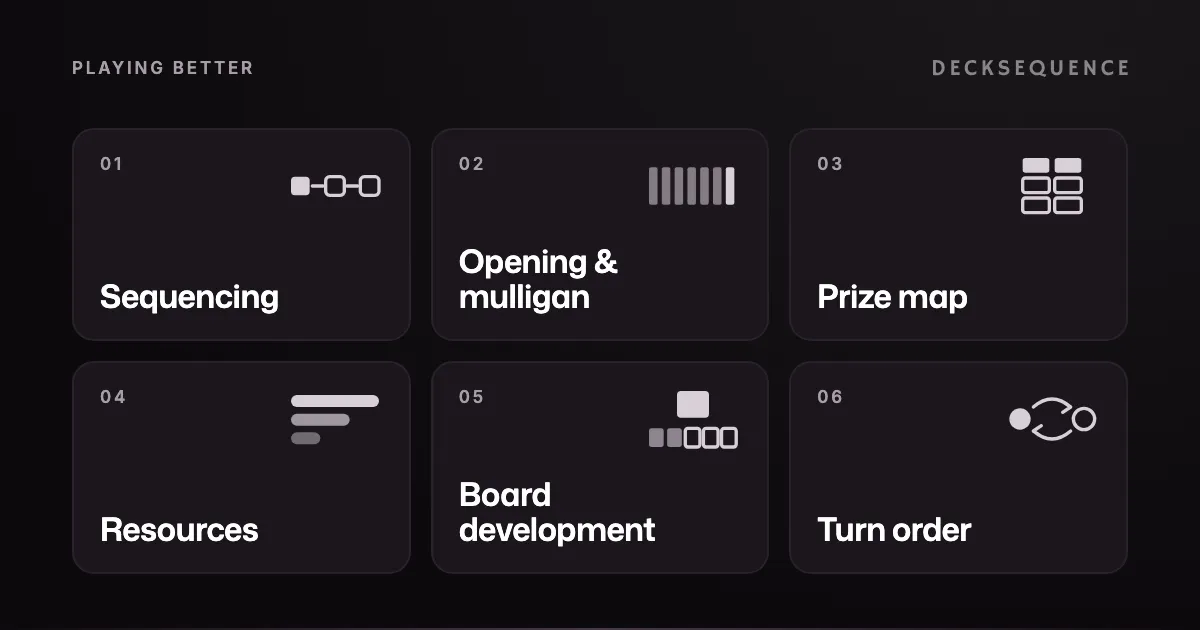
A win-loss record tells you whether you won, but not how well you played, and how you play is where most of your improvement comes from. "Play better" isn't much use as advice unless you can name the skills involved. Here are six, and all of them show up in games you're already playing.
The easiest way to review most of them is with the game in front of you. If you log your games in DeckSequence with their PTCG Live battle logs, each one becomes a replay you can step through turn by turn, and that's what most of the reviewing below assumes.
1. Sequencing
The order you make plays in within a turn. The same cards in a different order can lose a game you should have won, so search before you draw and think before you evolve. Sequencing has exact math behind it. In a replay you can see exactly which order you played things in, and whether you searched before you drew.
2. Opening and mulligans
How your games start: how often you mulligan and what your opening hands push you into. Most of this is decided by your list, since your Basic count sets your mulligan rate. Your deck's Odds page shows the rate your Basic count commits you to, and your replays show the mulligans you actually took.
3. Prize mapping
Planning the Knock Outs that add up to six Prizes, and the ones your opponent needs from you. Knock Outs and Prizes don't line up one for one. Most Pokémon give up one Prize card, a Pokémon ex gives up two, and a Mega Evolution Pokémon ex gives up three.
So a prize map looks something like "two ex Knock Outs and two single-Prize Pokémon", which is four Knock Outs for six Prizes, and the same arithmetic tells you which of your own Pokémon your opponent will go after. The sign you're not mapping is losing prize races by a single Prize, or running out of attackers one Knock Out short. Now and then that's just a faster opponent, but if it keeps happening, it's usually the plan. Every game you log in DeckSequence records the prizes each side took, so you can look back and see how close those losses really were.
4. Resource management
Making use of what you draw. You can only attach one Energy from your hand per turn, so a skipped attachment is gone for good, and a key card still in your hand at the end of the game did nothing for you.
Both are easy to check in a replay. Step to the final turn to see what was left in your hand, then look back through the turns for any that ended without an attachment. Each one is a specific card in a specific game, so they're good things to count across twenty games.
5. Board development
How quickly your board becomes a threat: getting an attacker ready and hitting your setup turns on time. This one pairs with the theory floor. Your list has a floor you can calculate from draws alone, and a tally from your replays shows whether you're beating it.
6. Adapting to turn order
Playing the seat you're in. Both seats see the same number of cards, but their first turns are different. Going first, you can't play a Supporter or attack on turn 1. Going second, you can do both, and you get to see your opponent's first turn before you commit. Going first and going second play differently, and since every logged game records who went first, you can sort your games by seat and step through a few of each to see whether you're adjusting.
How often to review
Some of these you can count, like mulligans, skipped attachments and dead cards. Others, like sequencing and prize mapping, you judge by watching the replay. Either way, what matters is which direction things are moving, and a handful of games tells you very little, because six games is mostly noise. Check in every twenty or thirty games and spend your practice time on whichever one is going the wrong way. Sign up for DeckSequence and your replays will be there when you do.