


Deck building basics
How many copies do you actually need? Checking it on your own list
By Johnnie Tirado
Founder of DeckSequence and competitive Pokémon TCG player.
· 5 min read
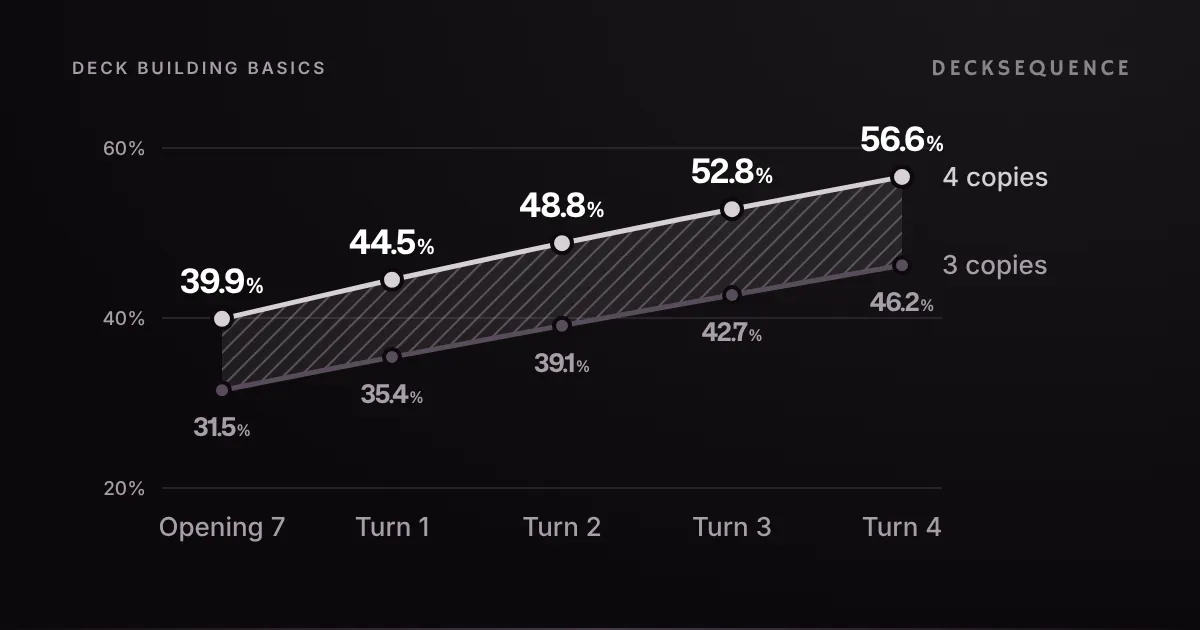
Run four copies of a card you need early in most games, and three of a card that can wait for the midgame. In a 60-card deck, the fourth copy adds 8.4 points to your chance of opening with one and 10.4 points by your turn 4, so the real question is whether that's worth the card it replaces.
What the fourth copy buys
The chance of having seen a card goes up with every card you draw, and so does the gap between three copies and four. Here it is from the opening hand to your turn 4, counting only the cards you draw. Your opening hand is 7 cards, and each turn's draw adds one, so by your turn 4 you've seen 11:
| By | 3 copies | 4 copies | Points added |
|---|---|---|---|
| Opening 7 | 31.5% | 39.9% | +8.4 |
| Turn 1 | 35.4% | 44.5% | +9.1 |
| Turn 2 | 39.1% | 48.8% | +9.7 |
| Turn 3 | 42.7% | 52.8% | +10.1 |
| Turn 4 | 46.2% | 56.6% | +10.4 |
Both players draw at the start of every turn, turn 1 included, so the table is the same going first or second. The fourth copy is worth a similar slice at every turn shown, between 8 and 11 points, growing a little with each draw: never small enough to ignore, and never close to making the card a sure thing. Even with four copies, close to half your games reach turn 3 without one drawn. The draw odds article explains why each extra copy adds less than the one before it.
Those are draw-only figures, which makes them a floor. Draw Supporters and search cards see more of the deck, so a real game finds the card more often than the table says. For a Pokémon that Ultra Ball or Buddy-Buddy Poffin can fetch, the copy count matters less than the number of ways to find it. For a card few things in your deck can find, the floor is closer to the truth.
A worked example: the fourth Boss's Orders
Take a sample Dragapult Dusknoir list on v1.2. It's the DeckSequence demo deck, not a tournament list. Its v1.0 ran four Boss's Orders, a later version cut one, and the player now wants to know whether the fourth should come back.
Start with when the deck needs it. Say the plan is to have a Boss's Orders in hand by your turn 3, for the Knock Out that sets up the rest of the game. By then you've seen 10 cards. With three copies you've seen at least one 42.7% of the time from draws alone, and with four, 52.8%. That's 10.1 points on the turn you care about. Boss's Orders is a Supporter, and the only card in this list that searches for one is the single Meowth ex, whose Last-Ditch Catch finds a Supporter when you play it from your hand to your Bench. That and extra draw lift both figures a little, so the draw-only numbers are close to the truth here, but count your own Supporter search before deciding the fourth copy is needed.
Then ask what comes out. In this list the obvious candidate is the single Judge. Swapping one Supporter for another keeps the deck's 11 Supporters at 11, so your chance of opening with a Supporter doesn't move. The cost is a disruption card you'll now see less often, which is a call about the matchups you expect, not something the math decides.
If the answer were Ultra Ball instead, the cost would be different: fewer ways to find Dreepy and Duskull in the opening turns. That's why it's worth checking the change as a whole list rather than one card at a time.
Checking it on your own list
DeckSequence does this for your own deck in Play Hands. Open a deck and choose Play Hands, on the web or in the app. It's free, with no limit on decks.
Play Hands works out the odds from your list's exact card counts. It shows your mulligan chance and how often your opening hand has a Basic Pokémon, a Supporter and an Energy, with a table of each by turns 1 to 4. To follow one card, like Boss's Orders, choose Track cards and pick it. That saves it as a card group. A group can be a single card, or every card that does the same job, and it gets its own figure for the opening hand and for each of turns 1 to 4.
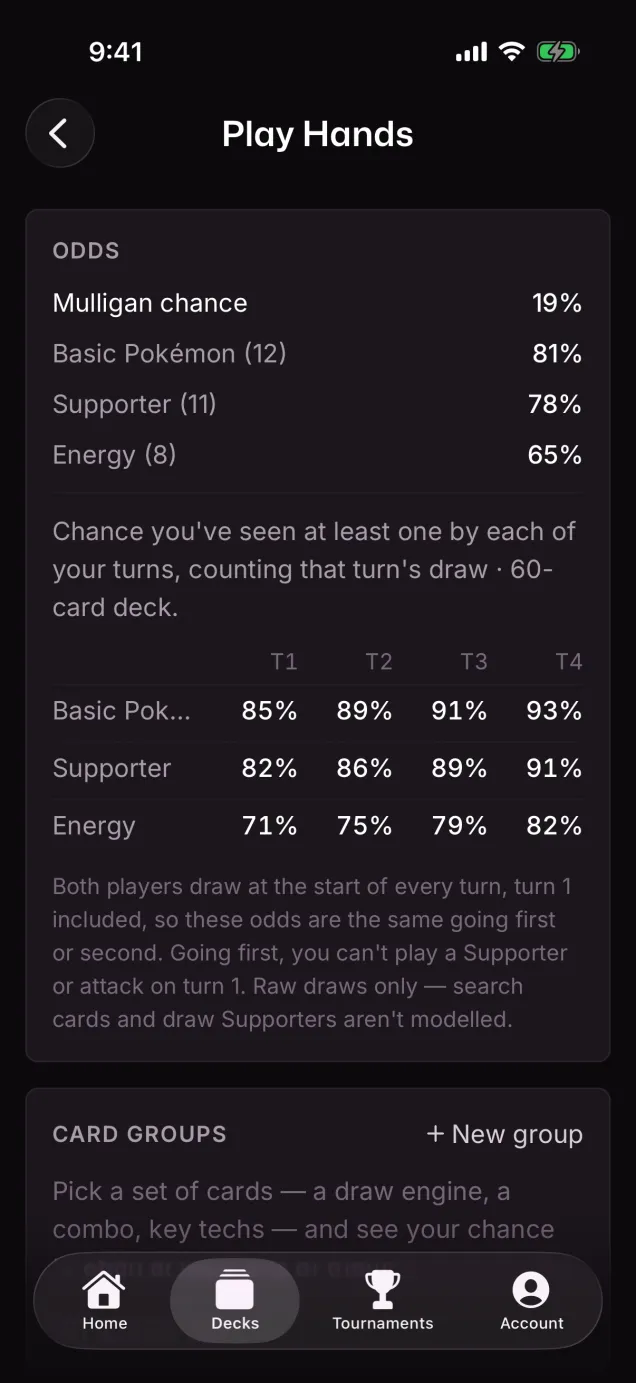
To try the fourth copy, change the count in the deck editor and don't save yet. While the list has unsaved changes, every figure in Play Hands reads the edited list, and an Odds impact panel sets the saved version's figures beside the new ones: the mulligan chance, Basic Pokémon, Supporter and Energy, and each card group and combo you've saved. Swap Judge for the fourth Boss's Orders and the Boss's Orders group moves while the Supporter row stays put. Cut an Ultra Ball for it instead and the Supporter row goes up, while a group of your search cards, if you track one, goes down. The panel compares opening hands, and the group's figures by turn read the edited list too. The same panel shows in the deck editor while you edit.
If the trade looks right, save it as a new version, v1.3 next to v1.2, so the matches you play on each list stay apart. If it doesn't, don't save it, and the saved version stays as it was. Play Hands covers card groups, combo odds and the playtest draw step by step.
Two things to keep in mind. The turn figures are the same draw-only floor as the table above, because draw and search cards aren't modeled. And for a Basic Pokémon, the hand you actually keep always has a Basic in it, so the raw opening-hand figure undersells it. Combo odds show an after-mulligans figure for that reason, and the mulligan math article explains why.
What the odds can't tell you
The odds say how often the fourth Boss's Orders shows up. They don't say whether the games you win with it are worth the games the cut Judge would have won. That part comes from playing the new version.
Because v1.3 is its own version, every match you log on it stays separate from v1.2. On Free you see each deck's overall record and win rate. Pro adds each version's record and win rate, and a head-to-head comparison of two versions, so after enough matches you can see whether the change helped. Until then, treat a handful of results as thin.
If you want to run the numbers on your own list before your next event, sign up, add your deck and open Play Hands.