


Beginners
Juniors, Seniors, Masters: age divisions explained
By Johnnie Tirado
Founder of DeckSequence and competitive Pokémon TCG player.
· 5 min read
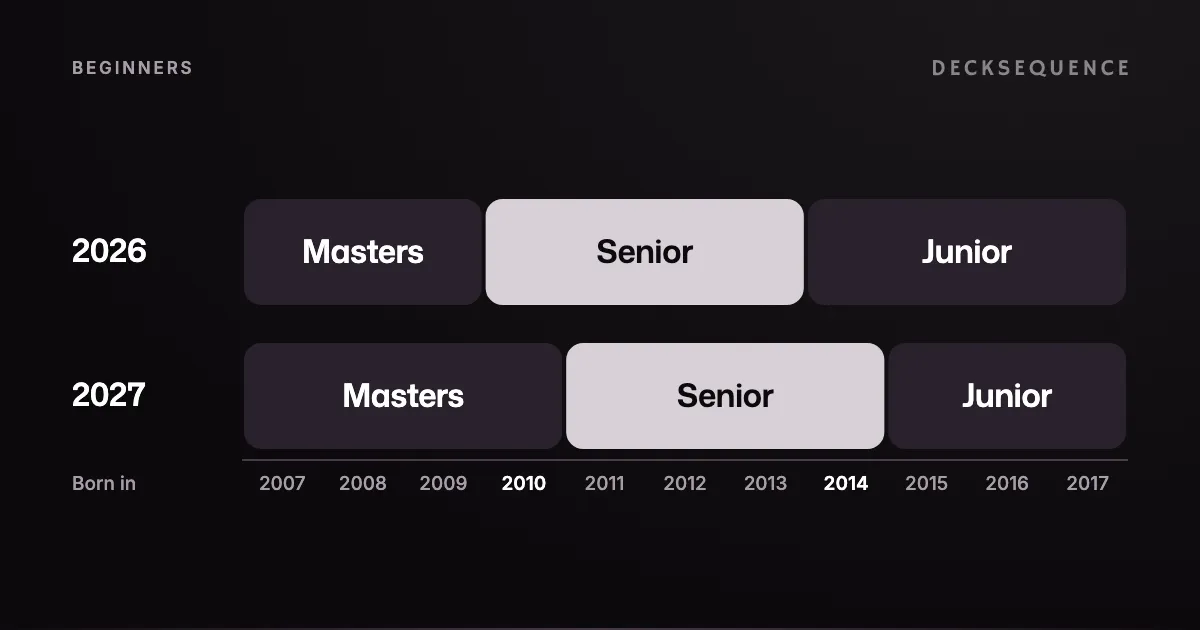
Play! Pokémon splits players into three age divisions, Junior, Senior and Masters, and places you by the year you were born, not by your birthday or your age on the day of the event. Your division is set when the season starts and holds for the whole season. In the 2027 season (September 2026 to August 2027), Juniors were born in 2015 or later, Seniors in 2011–2014 and Masters in 2010 or earlier.
Each season has its own table, and from the 2026 table to the 2027 one, every cutoff moved one year later. Play! Pokémon publishes each season's table before it starts, so check it again before you register next September. Where the divisions sit in the wider circuit is in how the events fit together.
How your division is decided
Three rules cover almost every case.
- Birth year only. A player born on January 1 and one born on December 31 of the same year are in the same division. The month and day never come into it.
- Fixed for the season. Your division is set at the start of the season and doesn't change during it, even if you have a birthday in the middle.
- The changeover is September 1. The season begins each year on September 1 at 00:00 UTC, and that is when divisions change over. If you're due to move up, you move up on that date, whatever month your birthday falls in.
Here is the current table, for the 2027 season:
| Division | 2027 season |
|---|---|
| Junior | Born in 2015 or later |
| Senior | Born 2011–2014 |
| Masters | Born in 2010 or earlier |
Senior covers four birth years, in this table and in the one before it. Junior has no lower limit and Masters no upper one.
Worked example: the same players across two seasons
The clearest way to see how the cutoffs move is to put the same birth years through two official tables. The 2026 table had Juniors born in 2014 or later, Seniors born 2010–2013 and Masters born in 2009 or earlier. The 2027 table is the one above.
| Born in | 2026 season | 2027 season |
|---|---|---|
| 2016 | Junior | Junior |
| 2015 | Junior | Junior |
| 2014 | Junior | Senior |
| 2013 | Senior | Senior |
| 2011 | Senior | Senior |
| 2010 | Senior | Masters |
| 2009 | Masters | Masters |
Two of those birth years changed division between the seasons. The player born in 2014 played the 2026 season as a Junior and plays the 2027 season as a Senior. The player born in 2010 went from Senior to Masters. Both moved on the September 1 the new season began, not on their birthdays.
The same table shows the edge case worth checking twice. Two children born weeks apart, one in December 2014 and one in January 2015, are in different divisions for the 2027 season: Senior and Junior. Being born in the same school year doesn't matter. The calendar year does.
If you're in a boundary year, the move up is the thing to plan for. You change opponents, and your Championship Points are ranked against a different division. Keeping each season's events in one place makes the step easy to see afterwards: in DeckSequence, every tournament holds its rounds, results and the deck you played, so each season's record stays readable after a move up.
Small events: when divisions are combined
A division needs six players to run on its own. When any division has fewer than six, the event uses age-combined play, also called age-modified Swiss: players from different divisions are paired together for the Swiss rounds, then separated again by division. The software combines them in this order:
- If there are fewer than six Juniors, they are combined with the Seniors.
- If that group still has fewer than six, Juniors and Seniors are both combined with the Masters.
- If there are at least six Juniors but fewer than six Seniors, the Seniors are combined with the Masters.
- If only the Masters have fewer than six, they are combined with the Seniors.
Combined divisions share Swiss pairings and nothing else. Each division keeps its own standings and, where there is one, its own top cut. An event can still run with as few as four players.
So a Junior at a small League Challenge might play Seniors or even Masters in the Swiss rounds, and still be ranked only against the other Juniors at the end.
What your division changes
Your division decides who you're measured against, at every level.
- Standings and top cut. Each division has its own standings after Swiss and its own single-elimination top cut where there is one.
- Champions. Even when divisions were combined for Swiss, prizes go to the winner of each division, so a small event can still crown a Junior, a Senior and a Masters champion.
- Championship Points. The official leaderboards rank players within each age division, so you're compared on points with your own division only. Championship Points explained covers how points lead to a Worlds invitation.
- Your decklist. The Play! Pokémon deck registration sheet asks for your date of birth and has you tick your division, at the top of the sheet.
DeckSequence can fill in that sheet from your deck and account, with your name, Player ID and date of birth, and print it as a PDF. One thing for parents: DeckSequence can't save a date of birth for a player under 13, so leave it empty and write it on the printed sheet by hand. Everything else still fills in. The tournament decklist guide has the steps.
If you're a parent, keep your player's record ready from the first round: sign up for DeckSequence and log your next Challenge round by round.